Voice Analytics for Contact Centers: How to Turn Every Call into a Revenue Opportunity

Voice Analytics for Contact Centers: How to Turn Every Call into a Revenue Opportunity


A modern contact center runs on conversations, and most of those conversations vanish the moment they end. They sit in a recording system, unread and unheard, while product, marketing, sales, and retention teams try to make decisions without them. That is the quiet cost of ignoring call center voice analytics. It is not just a customer experience visibility problem. It is a revenue problem.
This guide explains what call center analytics actually is, why it has become a strategic lever rather than a back-office tool, how it works, and how you can use every customer interaction to earn, retain, and grow.
Why Every Unheard Call Costs You Money?
Traditional QA programs sample two to four calls per agent per month. On a contact center floor of 500 call center agents handling tens of thousands of customer interactions a day, that is a rounding error. The remaining 98 percent of customer conversations carry buying signals, churn warnings, compliance slips, and coaching moments that no one ever sees.
That blind spot is expensive. According to Gartner, conversational AI deployments are projected to reduce contact center agent labor costs by $80 billion by 2026, with one in ten interactions fully automated. And PwC's 2025 Customer Experience Survey found that nearly one in three consumers walk away after a single bad experience. Each unheard call is a tiny leak. Stacked across a year, the damage to customer satisfaction and revenue is real.
What Voice Analytics for Contact Centers Really Means?
Voice analytics for contact centers is the use of AI to automatically interpret what customers and agents say, how they say it, and what that should trigger next. It sits at the heart of modern call center analytics, turning every customer call into usable customer data and structured and unstructured data your business can act on.
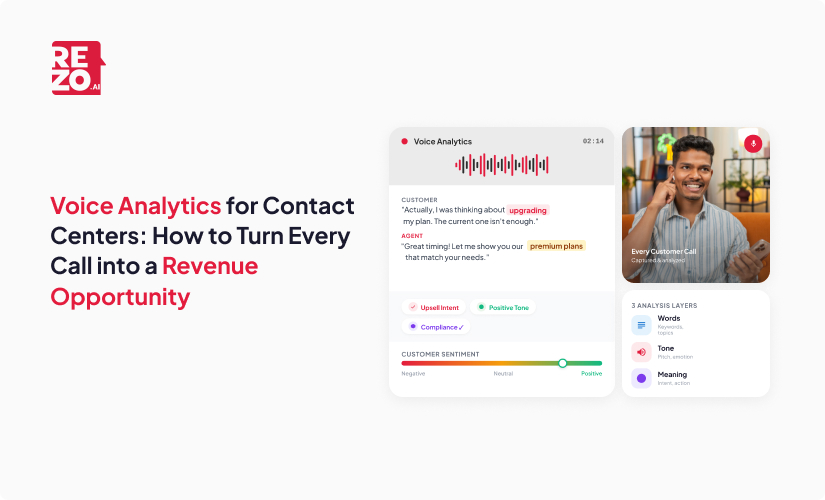
It works across three layers:
- Words: transcripts, keywords, topics, questions, objections.
- Tone: pitch, pace, emotion, stress, hesitation.
- Meaning: intent, sentiment, compliance status, next best action.
People sometimes use voice analytics and speech analytics interchangeably. The cleanest distinction: call center speech analytics examines conversations between customers and agents to identify key phrases and words using AI and machine learning, while voice analytics focuses on audio parameters like tone, pitch, stress, and rhythm. Most modern call center analytics software combines speech analytics and voice analytics, pairs them with sentiment analysis and text analytics, and extends the reach into chat, email, and messaging through conversation intelligence. Taken together, these interaction analytics turn every customer interaction into valuable insights and richer customer experience signals across the customer journey.
It is not the same as call recording or plain transcription. Recording preserves the audio. Transcription turns it into text. A good call center analytics platform turns that text plus tone into actionable insights and decisions.
Why Voice Analytics is Important?
Three forces have pushed call center analytics from nice-to-have to essential.
First, the analytics itself has caught up. Research shows that organizations using AI-driven analytics can unlock a 20 to 25 percent lift in operational efficiency.Zoom's State of AI in CX study has found that organizations using voice analytics can see up to a 31 percent increase in customer satisfaction ratings, largely because AI surfaces instant answers during live calls and reduces wait times — producing higher customer satisfaction and a stronger customer experience without adding headcount. These are not lab numbers. They are showing up in live call centers right now.
Second, the economics have shifted. Deloitte research has consistently shown that customer-centric companies outperform their competitors by significant margins. The old view of the call center as a cost center is fading. Leaders are calling it a value center, and they want the call center data and customer experience metrics to prove it.
Third, customer patience has thinned. Between channel switching, context carried from WhatsApp into a call, and rising compliance expectations, supervisors need a live pulse on every conversation. Sample-based QA cannot keep up. You need 100 percent coverage of customer interactions, and you need it now. If you want a primer on the broader shift, our take on the rise of AI in call centers is a useful starting point.
How Call Center Voice Analytics Actually Works?
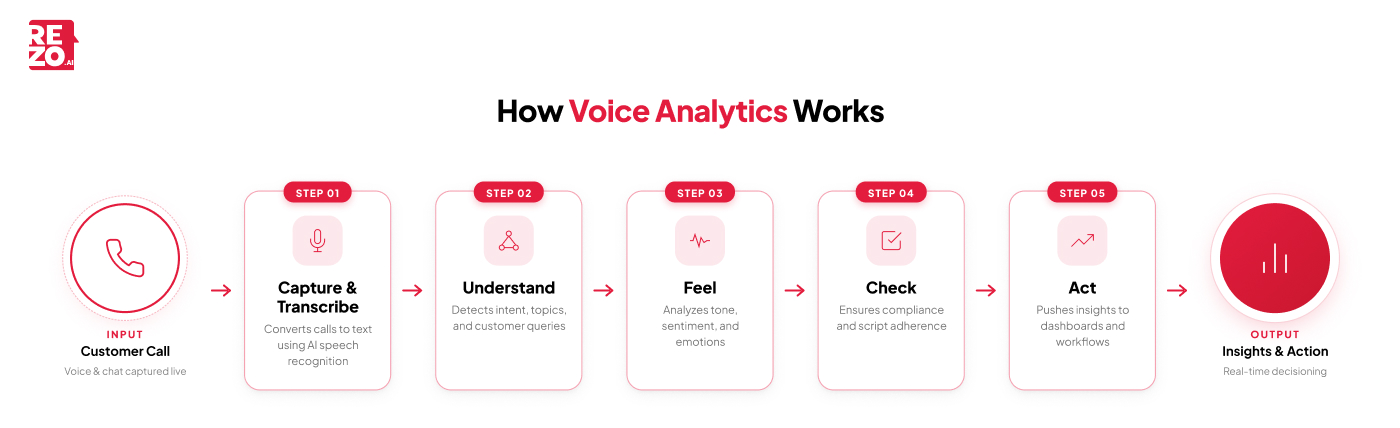
Under the hood, a modern call center analytics software stack looks like a five-step pipeline.
- Capture and transcribe. Calls stream from your telephony or CCaaS platform into automatic speech recognition tuned for accents, code-mixed speech, and noisy audio.
- Understand. Natural language processing and machine learning extract intent, entities, topics, and questions from every customer call.
- Feel. Acoustic models score customer sentiment, emotion, silence, and crosstalk across 100 percent of calls, not just a sample.
- Check. Rule engines and AI models verify script adherence, disclosures, and prohibited phrases, which keeps quality assurance and compliance on the rails in regulated industries.
- Act. Insights push into dashboards, real-time agent assist, QA workflows, and CRM updates, turning raw call center data and customer interaction data into business decisions.
The best call center analytics software does all of this on every call, in real time, with humans stepping in only for the high-value 10 percent that needs judgment. The result is a single feedback loop that keeps the call center, supervisors, and revenue teams aligned.
Where the Real Revenue Hides?
This is where voice analytics tools stop looking like a QA project and start behaving like a growth engine for the call center.
- Real-time intent detection. When a customer on a billing call says, "Actually, I was thinking about upgrading," a good intent model spots the cue and nudges the agent. A service call becomes a sales call without the customer feeling sold to. The same real-time layer sends instant notifications to supervisors during high-risk calls, so issues get caught the moment they surface.
- Upsell and cross-sell discovery. Call center analytics and speech analytics together learn what buying intent actually sounds like across thousands of customer interactions. They surface moments tied to life events, competitor mentions, and product gaps, natural openings to present relevant offers, deepen customer engagement, and elevate customer satisfaction.
- Churn save. Frustration shows up in tone long before it shows up in the words. Sentiment analysis flags at-risk customers mid-call so supervisors or retention playbooks can intervene before they cancel. Real-time speech analytics helps identify dissatisfaction early, reduces churn, lifts customer satisfaction, and uncovers the root causes of recurring customer issues.
- Coaching at scale. Top performers close differently. Call center analytics finds those patterns, identifies specific skill gaps in agent performance, and converts them into replicable coaching cards and personalized training programs. The same data-driven insights help the floor meet customer needs more consistently, lift agent performance week over week, and improve customer satisfaction over time. Continuous performance management built on call center analytics turns one-off wins into floor-wide standards and sharpens the customer experience every team delivers.
- Cleaner conversations. Silence, dead air, long holds, and clunky transfers quietly sabotage conversions. Contact center analytics makes them visible, which is the first step to eliminating them and helps enhance operational efficiency across call center operations and contact center operations alike.
A useful mental shift: voice analytics is strongest when it sits inside a cross channel analytics layer, where signals from voice reinforce what you see in chat, email, and WhatsApp. That is what drives consistent next best actions across the customer journey instead of siloed recommendations. The result is a steady stream of customer insights and actionable insights that any function can act on. Our deeper look at conversational AI walks through how that plays out.
A Lending Example
A lending operation noticed that borrowers who paused for more than four seconds after the first repayment ask were far more likely to default. Their call center analytics platform flagged those silences, surfaced an empathy-first rebuttal script, and pointed agents toward affordable restructuring offers. Recovery rates went up, customer complaints dropped, agent performance improved, the customer experience felt lighter, and overall call center performance lifted without new headcount.
An Automotive Example
An automotive dealer network deployed call center analytics software across service booking calls. The speech analytics layer flagged customer interactions that mentioned road trips, new family members, or moves across cities. Each became a trigger for agents to suggest tyre upgrades, extended warranties, or accessory bundles. What used to be pure service contact started contributing meaningfully to parts revenue, improved the customer satisfaction score month over month, and helped enhance customer satisfaction across the dealer network.
What Good Call Center Analytics Measures?
A strong call center analytics program produces one shared set of key performance indicators and key metrics the same key metrics that call center operations, customer service operations, CX, and revenue leaders all look at.
- Operations: first call resolution, average handle time, silence and hold ratio, contact center efficiency, overall call center efficiency
- Experience: sentiment trend, customer satisfaction score proxy, customer experience index, churn risk score
- Revenue: intent conversion rate, upsell attach rate, lead qualification accuracy
- Risk: compliance adherence, mandatory disclosure rate
When these key performance indicators and performance metrics live in one dashboard, conversations stop being debated. Decisions get made on evidence. Advanced analytics, contact center analytics, and predictive analytics surface customer insights daily, and call center efficiency becomes easy to benchmark across agents, teams, and queues. The same call center analytics also helps leaders identify trends, identify areas for improvement, and predict customer behavior before it shifts. Call volume patterns, agent performance trends, customer data, and customer experience signals all roll up to a single view, with advanced analytics and predictive analytics pointing to where customer behavior is heading next. Used well, this view helps leaders identify trends, surface customer issues early, and provide valuable insights that any team can act on.
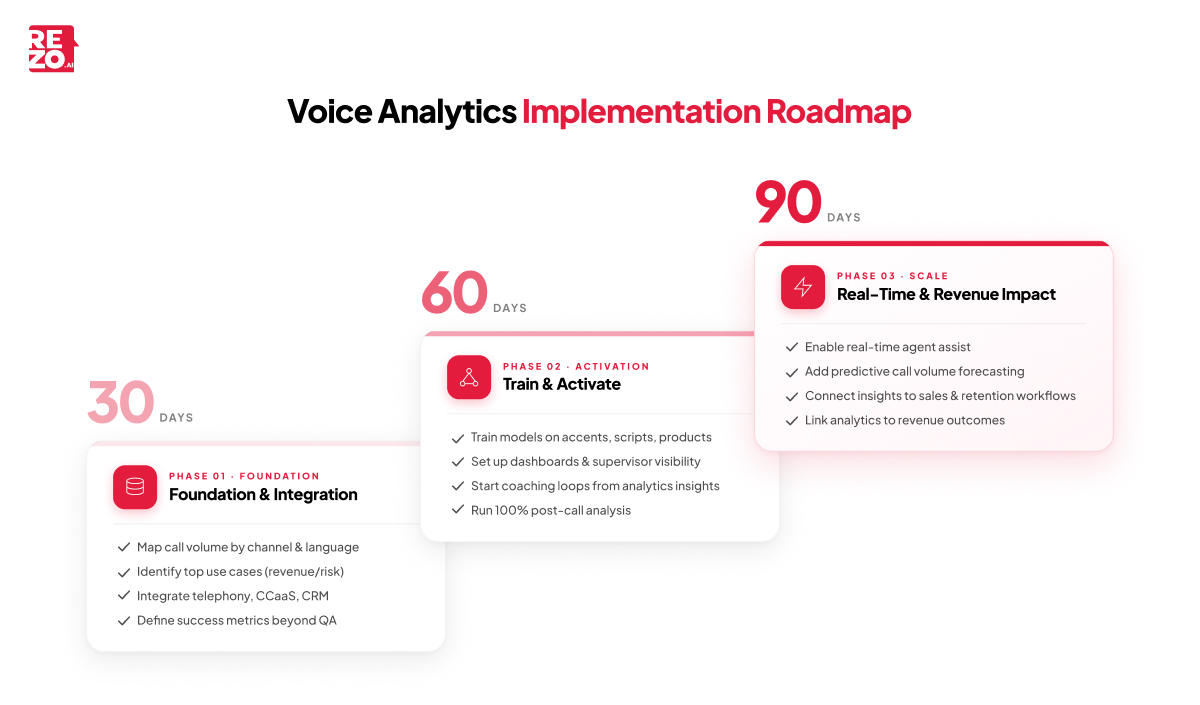
How to Implement Voice Analytics in 30-60-90 Days?
A sensible call center analytics rollout looks less like a big bang and more like a steady ladder.
Days 0 to 30: Anchor and integrate. Map call volume by channel, language, and business line, and benchmark current call volume against staffing, then plot expected call volume curves for peak and off-peak hours. Pick the top three use cases with a clear revenue or risk link, for example collections recovery, service-to-sales upsell, and compliance adherence. Integrate voice capture with your telephony, CCaaS, and customer relationship management system. Define what success looks like in business outcomes, not just QA scores.
Days 31 to 60: Train and activate. Train intent and language models on your actual accents, scripts, and product names. Set up supervisor dashboards that track agent performance daily and surface customer insights from every shift. Start weekly coaching loops where data-driven insights from call center analytics feed one-on-ones, lift agent performance, and close specific skill gaps through targeted training. Bake performance management cadences into the team rhythm so insights translate to behavior, and use interaction analytics to identify areas where customer needs are not being met. Layer in lightweight customer surveys after key journeys so survey signals reinforce what voice and speech analytics already show, and use the combined data to enhance customer satisfaction and provide valuable insights to product, marketing, and ops. Tight performance management cadences keep momentum from slipping between coaching cycles. Run post-call scoring on 100 percent of customer interactions before turning on real-time.
Days 61 to 90: Go real time and tie to revenue. Switch on real-time agent assist for priority queues. Layer in call center predictive analytics to forecast call volume by hour, predict customer behavior in peak windows, and prepare staffing accordingly. Wire insight signals into WFM and QA. Connect intent and customer sentiment flags to your sales and retention workflows. Link the program to revenue, customer experience, and operational efficiency targets and review weekly. Layering in strong AI governance during this phase saves a lot of pain later.
Done well, most enterprises see measurable movement on first call resolution, AHT, and conversion inside 90 days, with revenue impact compounding over the next two quarters and noticeable lift in overall call center performance and center performance benchmarks.
How to Pick the Right Voice Analytics Partner?
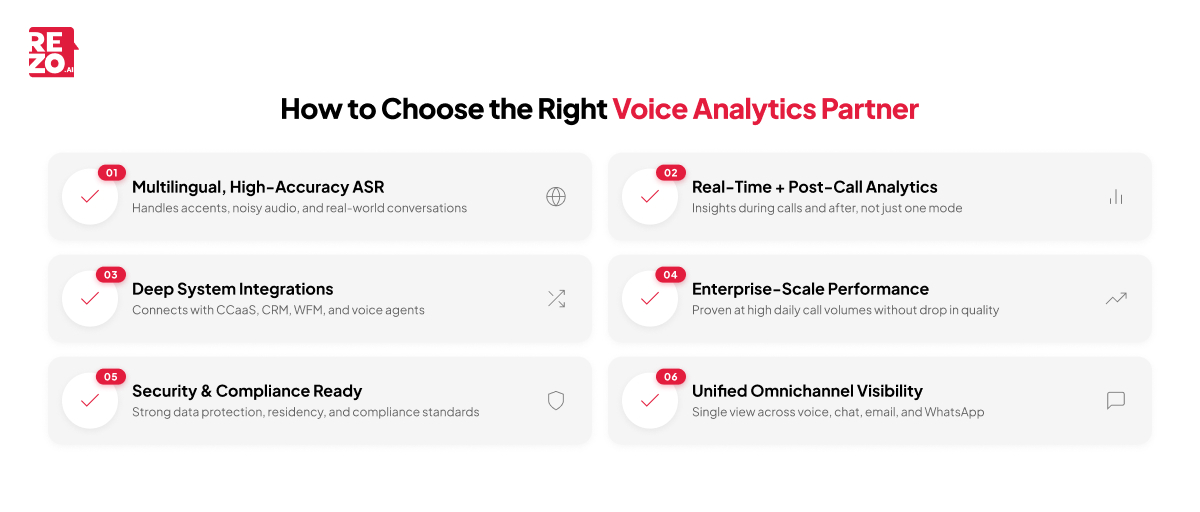
Once you move past feature checklists, the right call center analytics software partner tends to have a few things in common.
- Multilingual, accent-tolerant ASR with strong accuracy on real-world audio
- Real-time and post-call modes, not one or the other
- Native integrations with your CCaaS, customer relationship management, WFM, and agentic voice agents
- Enterprise scale proven at high daily call volumes
- Strong security, data residency, and compliance posture
- Unified visibility across voice, chat, email, and WhatsApp so you are not stitching together reports by hand
The strongest voice analytics tools are not standalone analytics software. They are part of a Unified CX platform where call center analytics software, contact center speech analytics software, speech analytics software, and voice analytics software, plus QA, agentic voice bots, and reporting, live in one system, feed each other, and provide valuable insights that enhance customer interactions across every channel. Done right, this stack reshapes customer service processes end-to-end, lifts the customer experience, and gives leaders one place to manage performance metrics across the entire floor.
Where Call Center Analytics Is Headed: From Insight to Action
The next frontier is agentic. Instead of surfacing an insight and waiting for a human, call center analytics software will trigger the response directly. A churn signal spins up a retention voice bot. A detected upsell cue fires off a WhatsApp offer and schedules a callback. Generative models write the call summary and update the CRM with fresh customer interaction data and contact center data. Insights move from dashboards into decisions. You can see the shape of that future in agentic AI for the contact center.
Expect call center analytics and contact center analytics to quietly become the nervous system of the modern contact center, sensing, interpreting, and acting across every channel and turning every customer interaction into measurable business outcomes and a sharper customer experience.
Conclusion: From Listening to Earning
Every call your contact center takes is a tiny business decision. Multiply that across hundreds of thousands of conversations a month and call center analytics stops being a QA tool and becomes the shortest path to protecting revenue, coaching your people, and growing customer value. The enterprises that will win are the ones that treat every customer interaction as a strategic asset and use the right call center analytics software to act on it in real time.
Frequently Asked Questions
How accurate is voice analytics today?
Enterprise-grade call center voice analytics typically delivers 85 to 95 percent transcription accuracy and strong intent detection, depending on audio quality, language mix, and domain-specific training. Accuracy rises quickly once the models are fine-tuned on your own customer calls, accents, and product vocabulary over the first few weeks of deployment.
Is voice analytics the same as conversation intelligence?
Not exactly. Voice analytics focuses on audio-based customer interactions. Conversation intelligence is broader and covers voice, chat, email, and messaging together. Most modern call center analytics platforms position voice analytics as one layer inside a larger conversation intelligence stack so insights stay consistent across every channel a customer uses.
How do you measure the success of a voice analytics program?
Track a short list of business-level performance metrics, not just QA scores. Useful ones include intent-to-conversion rate, upsell attach rate, churn risk reduction, first call resolution, agent performance, compliance adherence, agent coaching throughput, and customer experience indicators that tie back to retention. Supplement them with post-call customer surveys after high-stakes interactions to validate signals from the voice side. Review everything weekly and connect it to the revenue, retention, and risk targets your leadership already cares about.
Frequently Asked Questions (FAQs)


Take the leap towards innovation with Rezo.ai
Get started now