AI Voice Agents for OEMs: A Smarter CX Playbook

AI Voice Agents for OEMs: A Smarter CX Playbook


Picture this: a safety recall hits, and overnight your national contact center is flooded with thousands of anxious calls. Hold times spike, every available agent is overwhelmed, and frustrated customers take their complaints to social media. For large OEMs, this is not a hypothetical scenario. It is Tuesday.
The reality is that the AI voice agent is no longer a futuristic concept for OEMs. It is a strategic necessity. Experts have consistently emphasized that customer experience is the new competitive battlefield for automakers, and the numbers back it up. The automotive AI market is projected to reach USD 51.68 billion by 2034, growing at a 16.7% CAGR (Fortune Business Insights). Meanwhile, consumers reported frustration with traditional phone calls to service lines, highlighting the urgent need for smarter conversations and AI-driven engagement.
This article is not about dealership-level chatbots or in-vehicle voice assistants. It is about how OEMs can deploy enterprise-grade AI voice agent systems across their contact center operations, from recall management to warranty processing and beyond.
What Are AI Voice Agents and Why Should OEMs Care?
An AI voice agent is an intelligent, conversational AI system powered by speech recognition and natural language processing (NLP) that understands caller intent, responds naturally in real time, and can execute tasks autonomously. Modern voice agent platforms combine large language models and text to speech technology to deliver natural, fluid conversations without awkward pauses or robotic responses. If you have ever navigated a clunky IVR menu ("press 1 for service, press 2 for billing"), you already know what these AI agents are replacing.
Traditional IVR forces callers through rigid call flows and menu trees. Basic chatbots and commerce agents handle text but struggle with the nuances of spoken language. The AI voice agent is fundamentally different. It processes natural speech, understands context and sentiment, handles interruptions, and can respond naturally in fluid, human quality conversations. These agents do not just respond to queries. They resolve customer issues and complete tasks end to end, taking meaningful actions within your existing system workflows.
This is the era of autonomous AI, where a single voice agent can function as a digital worker capable of completing end-to-end workflows without human intervention. Autonomous agents are expected to resolve 80% of common contact center calls by 2029, fundamentally reshaping how organizations handle inbound and outbound calls at enterprise scale.
For OEMs handling lakhs of monthly interactions (recalls, warranty claims, scheduling appointments, parts inquiries, and after-sales follow ups), the math is compelling. You cannot scale human teams fast enough to match the pace and unpredictability of customer demand. Voice agents give OEMs the capacity to handle millions of calls with consistent performance and around-the-clock availability. A modern AI voice agent can handle millions of concurrent calls globally with low latency, ensuring that every caller receives a timely response regardless of volume spikes.
Why the Status Quo Fails OEM Customer Service?
OEM contact centers are among the most complex in any industry. On any given day, they juggle recall notifications, warranty claim intake, service scheduling, parts availability inquiries, after-sales follow ups, and escalated complaints. Each interaction type has its own data requirements, workflows, and emotional dynamics.
When a recall event hits, call volumes can spike 5x to 10x overnight. A single human agent simply cannot absorb that kind of surge, and scaling human teams leads to ballooning hold times, missed calls, and declining service quality. Warranty claim processing, often manual and paper-heavy, creates backlogs that delay resolution and erode trust among customers who expect faster outcomes.
Then there is the multilingual challenge. OEMs operating across states and countries must support diverse languages, dialects, and cultural nuances, often simultaneously. Customers today reach out across phone calls, email, chat, and WhatsApp, but most OEMs still lack a unified, voice-first system that ties all of these touchpoints together. Without integration with existing systems and a consistent interaction layer, these conversations happen in silos and critical data gets lost.
Deloitte's State of AI in the Enterprise report found that while enterprises continue to increase AI spending, many struggle to translate that investment into measurable outcomes. For OEMs, this underscores a critical point: adopting technology without a clear, use-case-driven strategy leads to wasted spend and stalled initiatives. Industry leaders who succeed are the ones aligning AI deployment to specific, high-impact use cases with full control over the implementation roadmap.
How AI Voice Agents Solve Real OEM Problems?
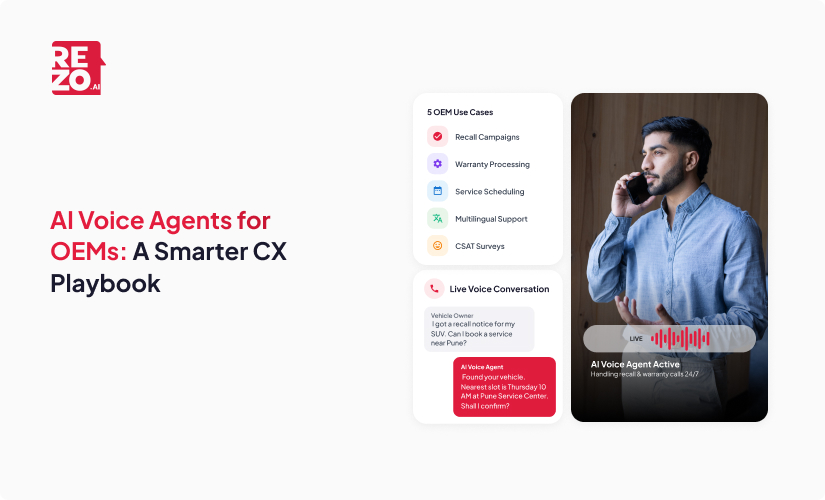
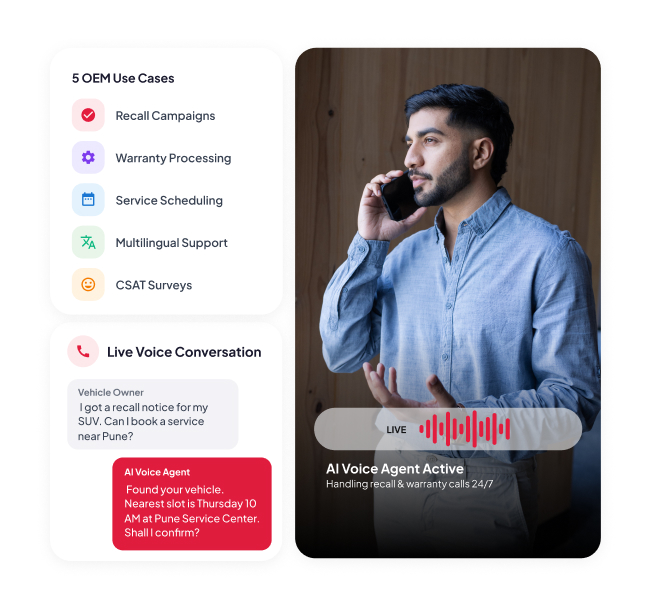
Theory is helpful, but what does voice AI actually look like in practice? Here are five high-impact use cases that OEM leaders will immediately recognize.
Recall Campaign Management and Proactive Outreach
When a recall is announced, speed and coverage matter. An AI voice agent can proactively call affected vehicle owners, explain the recall clearly, answer common questions, and schedule service appointments, all without human intervention. The agent handles thousands of simultaneous outbound calls as part of structured outbound campaigns, compressing campaign timelines from weeks to days. These agents can handle millions of calls reliably, maintaining consistent performance even during peak demand surges. For callers who are anxious or have complex questions, the AI voice agent escalates seamlessly to a human agent with full context already captured. This is voice AI agents for recall management at OEM scale, turning a reputational risk into a demonstration of brand responsiveness.
Warranty Claim Intake and Processing
Warranty claims are a pain point for both customers and OEM teams. The voice agent collects claim details through natural conversation, verifies warranty eligibility by pulling vehicle history from integrated systems, and initiates processing in real time. Industry benchmarks suggest that AI can reduce warranty claim handling costs by 15–30%, with some implementations reporting reductions as high as 30–50% in highly automated environments, a significant saving when you multiply it across thousands of monthly claims. By integrating with ERP and warranty management systems, the voice agent eliminates manual data entry, reduces processing errors, and improves overall agent efficiency. The ability to complete workflows autonomously means fewer bottlenecks and faster resolution for every claim.

Service Appointment Scheduling
Customers want to book, reschedule, or cancel service appointments without waiting on hold or navigating complex phone menus. An AI voice agent handles booking appointments through natural conversation, syncing with the OEM's dealer management system (DMS) to check slot availability across the service network. The agent can confirm the appointment via a follow-up call, send an SMS or WhatsApp message, and even handle last-minute rescheduling requests. The result is a frictionless interaction that keeps customers engaged and reduces no-shows. Non technical users on the operations side can configure call flows and agent behaviour through intuitive dashboards, giving teams control over how conversations are managed without writing a single line of code.
Multilingual and Regional Customer Support
For OEMs serving diverse markets (think India, Southeast Asia, or the European Union), multilingual support across multiple languages is not optional. An AI voice agent can converse fluently in multiple languages and handle code-switching naturally, for example, a caller mixing Hindi and English in the same sentence. This is critical for Indian OEMs and any manufacturer with a geographically distributed customer base. The brand voice and service quality remain consistent, regardless of which language customers speak. Advanced voice agents high accuracy in handling conversations across accents, dialects, and regional variations, ensuring that every live call feels natural and contextually appropriate.
After-Sales Follow-Up and CSAT Surveys
The customer relationship does not end at the point of sale or service. AI voice agents automate post-service follow-up calls to gauge satisfaction, collect structured feedback, and flag at-risk customers who may be considering a competitor. This data feeds directly into analytics tools for continuous CX improvement. Enterprises deploying conversational AI agents can achieve 20% to 30% cost reductions in contact center operations, making after-sales automation one of the most immediate paths to measurable value. Each AI agent takes meaningful actions based on real time feedback, from triggering retention workflows to updating CRM records, all within the same conversation.
What Does Implementation Look Like? A Practical Roadmap for OEMs
Implementation is where many enterprises stumble. Recent industry surveys have found that AI investment continues to rise, but tangible results remain elusive for organizations that lack a structured deployment strategy. A phased approach with clear milestones reduces risk, accelerates time to value, and ensures fast deployment of tools that deliver immediate ROI.
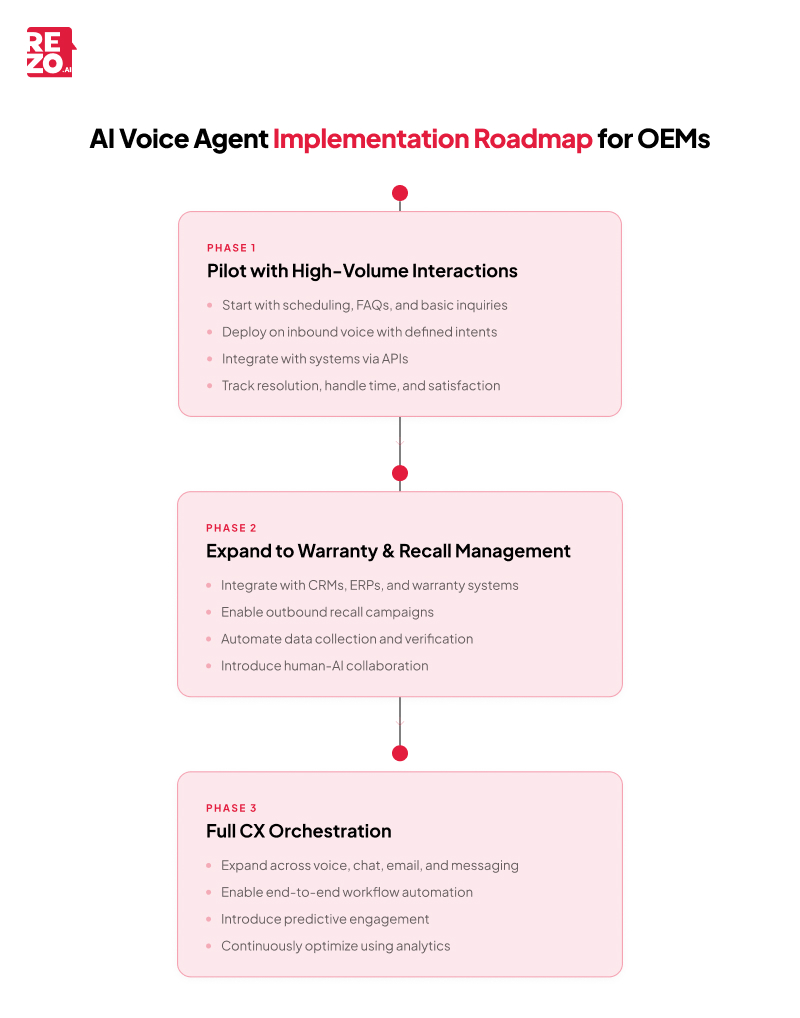
Phase 1: Pilot with High-Volume, Repetitive Interactions
Start where the volume is highest and the complexity is lowest. Scheduling appointments, basic inquiries, and FAQ resolution using a centralized knowledge base are ideal candidates for a pilot. Deploy AI agents on a single channel (inbound voice calls) with a defined set of intents, and connect each agent to your existing systems through native API integrations. Measure first-call resolution rate, average handle time, agent performance, and customer satisfaction scores rigorously. This phase typically takes 4 to 8 weeks and produces the data you need to justify broader investment.
Phase 2: Expand to Warranty and Recall Management
With pilot results in hand, integrate the voice AI platform with your warranty management system, ERP, and CRM. Add outbound capabilities for recall campaigns, enabling each AI voice agent to manage both inbound and outbound calls across your entire customer base. This is also where human-AI collaboration becomes essential: the voice agent handles Tier-1 interactions (data collection, verification, scheduling) while escalating complex calls to a human agent with full conversational context. Agent behaviour and decision making logic can be fine-tuned based on conversation analytics and real time data. Timeline: 8 to 16 weeks.
Phase 3: Full CX Orchestration
In this phase, you deploy AI voice agents across all channels and integrate them with chat, email, and WhatsApp for a truly unified customer experience. This is where voice AI agents for OEMs deliver their full strategic value. Enable predictive engagement, where the AI agent identifies at-risk customers and proactively reaches out before they churn. Continuous efforts to optimize performance through analytics, feedback loops, and model retraining become a quarterly discipline. This is where voice AI implementation for automotive manufacturers evolves from a point solution into a strategic CX platform, with each agent managing complete workflows across every touchpoint.

Key integration requirements across all phases include connectivity with your CRM, DMS, ERP, warranty management system, and quality management system. Many leading AI platforms also support SIP trunking for telephony integration, allowing OEMs to connect their existing phone infrastructure without overhauling their tech stack. The right platform will support these integrations natively, not through brittle custom connectors, and give your team control over call routing, escalation logic, and agent configuration.
How to Choose the Right Voice AI Platform for Your OEM
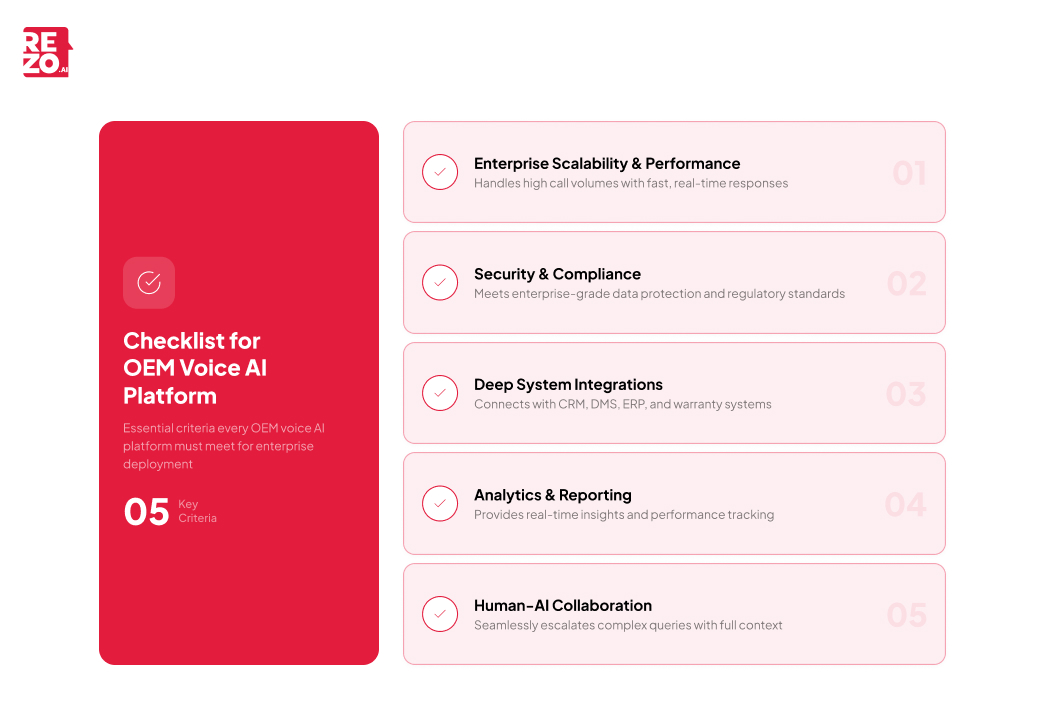
Not all voice AI platforms are built for the scale and complexity of OEM operations. Here is what to evaluate:
- Enterprise scalability: Can the platform handle millions of concurrent calls across geographies with low latency and without degradation? Look for sub second latency in agent responses to maintain natural conversations and avoid disruptions during live calls. The ability to scale from hundreds to millions of calls without manual intervention is what separates enterprise-grade tools from basic offerings.
- Enterprise grade security and compliance: Automotive OEMs operate under GDPR, CCPA, and regional data protection standards. The platform must deliver enterprise grade reliability with 99.99% uptime and meet industry standards for data security natively. Enterprise grade security is non-negotiable for any production deployment where customer calls carry sensitive information.
- Deep integration with existing systems: Beyond CRM, does the system connect to DMS, ERP, warranty management, and quality management platforms? The ability to integrate with other platforms through APIs is critical for each AI agent to complete tasks and take actions within your workflows. Look for tools that support SIP trunking, native CRM connectors, and pre-built integrations with your tech stack.
- Analytics and reporting: Real time dashboards, conversation intelligence, and actionable insights are essential for continuous improvement. Track agent performance metrics and maintain control over how each AI agent behaves in production conversations. The best platforms correlate interaction data directly to business outcomes for measurable ROI.
- Human-AI collaboration: The best platforms do not replace your human agents. They augment them, handling routine calls and conversations while routing complex interactions with full context to a human agent. The goal is better agent efficiency across all calls, not agent replacement, with conversational AI tools that make every customer interaction more productive.
What the Future Holds: OEMs and the AI Agent Era
The trajectory is clear, and it is accelerating. Industry analysts predict that 40% of enterprise applications will feature task-specific AI agents by 2026, up from less than 5% in 2025. Forrester's 2026 predictions indicate that 30% of enterprises will create parallel AI functions that complement human agents in service roles.
Voice agents are evolving from single-task automation into multi-step, context-aware AI agents that can handle entire customer journeys autonomously. An advanced AI voice agent can manage pre-call, in-call, and post-call actions, enabling OEMs to define custom call flows that govern how calls and conversations flow from start to finish. According to McKinsey, more than 90% of vehicles sold in 2030 will be connected, creating new data streams and customer touchpoints that voice AI can leverage.
For OEMs, this convergence of connected vehicles, agentic AI, and rising customer expectations means that the window to build a competitive CX advantage is now. The manufacturers that invest in voice AI infrastructure today will be the ones leading in customer experience, fielding more calls with greater efficiency as vehicles become increasingly software-defined. This shift is not just about efficiency. It is about building a customer relationship layer that scales with your business and gives you control over every conversation.
Conclusion
The AI voice agent for OEMs is no longer experimental. It is a proven, enterprise-grade capability that leading manufacturers are deploying to transform contact center operations at scale. From recall campaign management to warranty processing, booking appointments to multilingual support, the use cases are tangible, and the results are measurable.
The gap between OEMs investing in voice AI and those clinging to legacy systems will only widen as customer expectations continue to rise. Start with a focused pilot, prove value on your highest-volume use cases, and scale strategically with a phased roadmap. The right AI platform partner, one that combines enterprise scalability, deep system integrations, low latency, and intelligent AI agent orchestration, makes the difference between a successful transformation and a stalled initiative. Deploy AI where it matters most, and let your AI voice agent handle the calls that drive your business forward.
Frequently Asked Questions
How do you measure the ROI of AI voice agents?
Track key metrics including cost per call, average handle time, first-call resolution rate, call containment rate, and CSAT scores. The formula is: Total Benefits (cost savings + revenue gains + CX improvements) divided by total voice AI investment, multiplied by 100. Correlating these metrics directly to business outcomes ensures your AI agents are delivering measurable value across all calls and conversations.
How do AI voice agents handle different accents and dialects?
Modern voice AI is trained on diverse global speech patterns, achieving high accuracy across accents. Advanced recognition systems use real time accent adaptation and automatic language detection to handle code-switching, regional slang, and phonetic variations without losing conversational context. The best platforms deliver natural, human quality conversations regardless of accent, ensuring that all customers receive the same quality of interaction.
Frequently Asked Questions (FAQs)


Take the leap towards innovation with Rezo.ai
Get started now