Conversational AI for Lead Generation: 4 Step Roadmap

Conversational AI for Lead Generation: 4 Step Roadmap
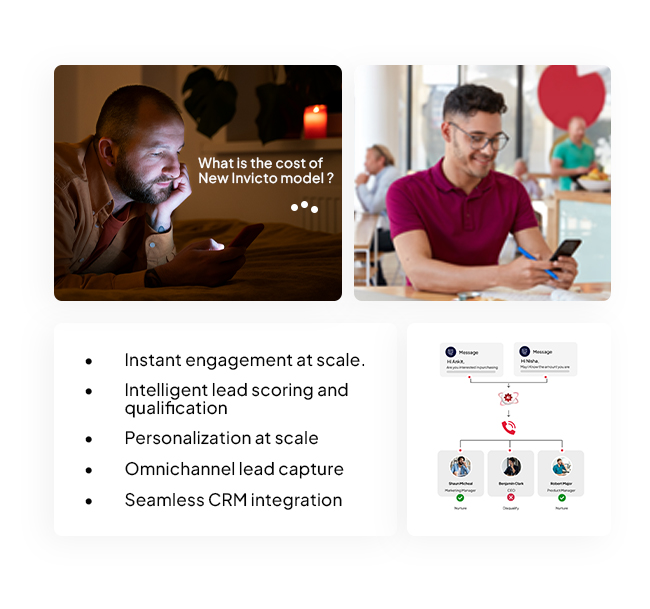


Your prospects are already talking. They are messaging on WhatsApp at midnight, browsing your website during lunch breaks, and asking questions on social media before their morning coffee. The real question is: who is answering them?
For enterprises handling thousands of customer inquiries every day, conversational AI for lead generation is no longer a futuristic concept. It is the competitive edge separating companies that capture demand from those that let it slip through the cracks. According to Salesforce, AI powered lead generation delivers 50% more sales-ready leads and reduces customer acquisition costs by up to 60%. Those are not marginal improvements. That is a fundamental shift in how pipelines get built and how sales and marketing teams drive business development.
Let us walk through exactly how AI lead generation works, why it matters, and how your organization can refine its lead generation strategy with the right ai lead generation tools.
Why Is Traditional Lead Generation Falling Short?
If your lead generation strategy still depends heavily on static web forms and cold outbound calls, you are fighting an uphill battle. Here is what the data tells us.
Web form conversion rates have been declining for years. Prospects abandon lengthy forms because they want answers, not paperwork. They do not want to collect contact details just to get basic information. Meanwhile, cold outbound calls yield diminishing returns. Rising customer acquisition costs make the spray-and-pray approach unsustainable for marketing and sales teams at mid-market and enterprise scale alike.
Then there is the speed problem. Research consistently shows that potential leads go cold when follow-up is delayed beyond the first few minutes. Yet most sales teams cannot respond instantly, especially to after-hours inquiries. Those late-night browsing sessions from website visitors and weekend questions? They get lost entirely because there is no mechanism to engage leads at the exact moment of intent.
Manual lead qualification compounds the issue further. Without ai lead generation tools, human-driven lead scoring is inconsistent, typically hovering around 30 to 40% accuracy compared to AI-driven approaches. Sales teams end up spending more time chasing unqualified leads than actually closing deals. The result is frustrated reps, bloated sales funnels, and missed revenue targets.
The bottom line: traditional methods were built for a different era. Today's buyers expect instant, relevant, and personalized interactions, and they will move on if they do not get them. The current lead generation process at most organizations cannot keep pace with how modern buyers actually behave.
What Is Conversational AI for Lead Generation?
Conversational AI refers to AI-powered systems that use natural language processing (NLP), natural language understanding (NLU), and machine learning algorithms to engage prospects in natural, two-way conversations across multiple channels. This AI technology and natural language processing capability represent a fundamental leap forward for lead generation.
This is not the same as a rule-based chatbot that follows rigid scripts. Modern conversational AI chatbots bring context awareness, intent recognition, sentiment analysis, and adaptive dialogue to every interaction. These AI systems understand what a prospect is asking, why they are asking, and how to guide them toward the next best step. They can identify patterns in lead behavior and stated preferences to deliver the most relevant response.
The omnichannel dimension is critical for enterprises. AI lead generation tools operate seamlessly across website chat, voice calls, WhatsApp, SMS, and social DMs, meeting potential customers wherever they prefer to communicate. Every interaction is an opportunity to collect contact details, understand pain points, and move potential leads further down the sales funnel.
Voice AI deserves special attention as a lead generation channel. AI voice bots now handle both inbound and outbound calls, qualify interest through natural conversation, and schedule meetings directly on sales reps' calendars. These AI agents can engage leads across time zones, turning website visitors into booked appointments. Organizations in financial services, for instance, are already seeing transformative results with AI voice bots in banking.
How Does Conversational AI Transform Lead Generation?
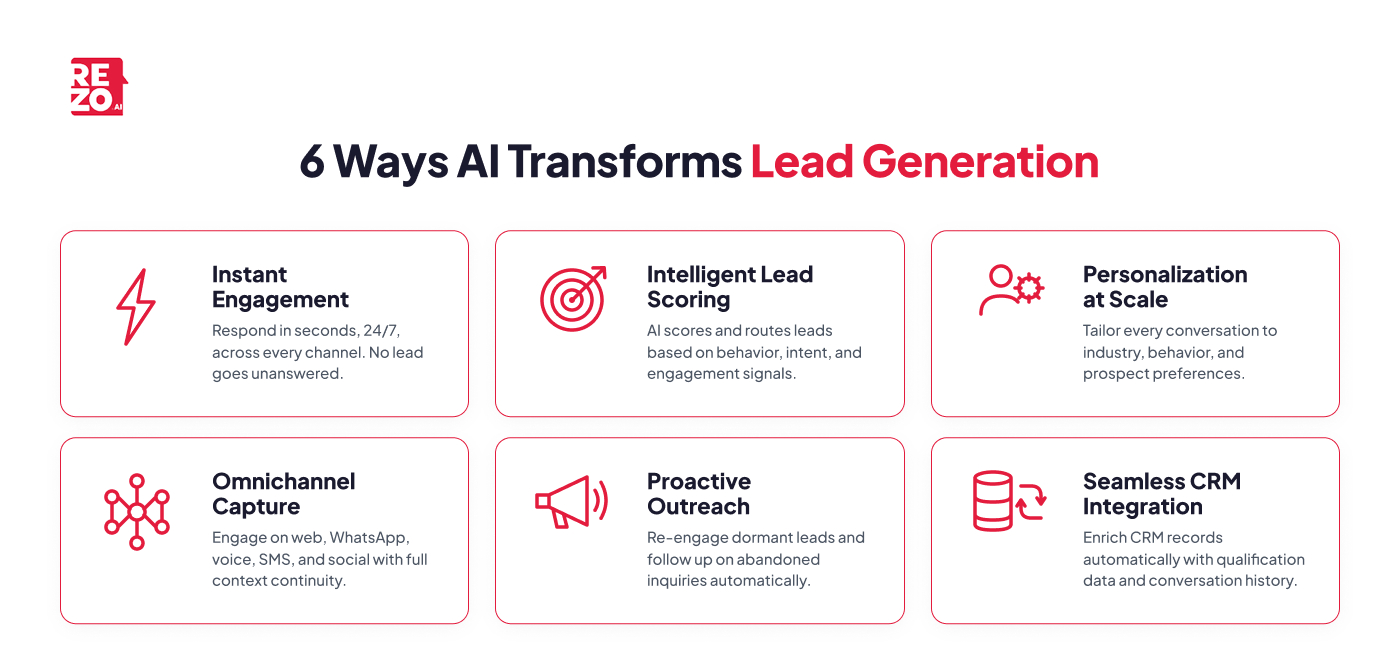
The transformation happens across six key dimensions, and each one addresses a gap that traditional lead generation efforts simply cannot fill.
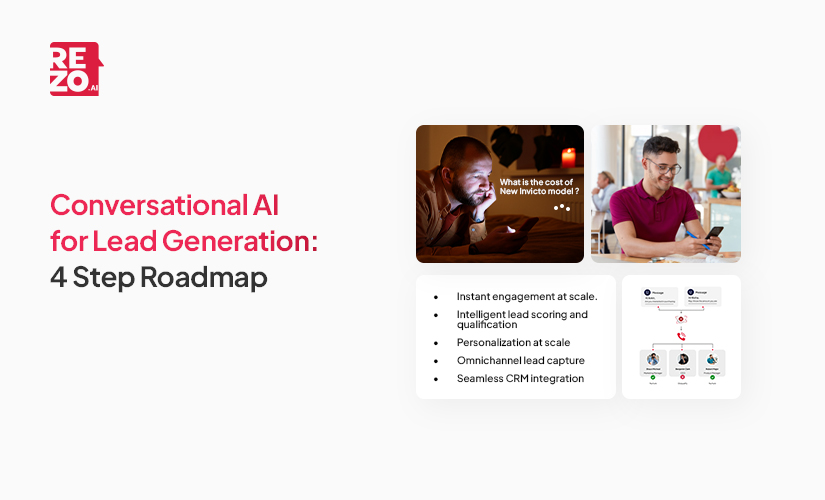
- Instant engagement at scale. When a prospect visits your website or sends a WhatsApp message, conversational AI responds in seconds. Not minutes. Not hours. Seconds. AI agents operate 24/7, across every channel, ensuring no inquiry goes unanswered regardless of time zone or volume spikes. This matters because potential customers expect immediate responses, and every delayed reply is a lost opportunity in your lead generation efforts.
- Intelligent lead scoring and qualification. Instead of relying on a form submission to guess intent, AI lead generation tools ask the right questions in real time. AI algorithms score leads based on responses, lead behavior, and engagement signals, then route the most promising leads directly to your sales teams while nurturing others automatically. Predictive lead scoring uses AI algorithms and predictive analytics to prioritize leads based on all the data available, from browsing patterns to past interactions to firmographic signals. This approach to automating lead qualification ensures your team focuses on high quality leads rather than chasing dead ends.
- Personalization at scale. Every conversation is tailored based on the prospect's behavior, past interactions, industry, and customer preferences. AI lead generation tools analyze customer data to deliver marketing messages that resonate with each prospect's specific situation. A telecom executive exploring enterprise plans gets a very different experience from a small business owner comparing basic options. This personalization directly improves engagement and conversion rates.
- Omnichannel lead capture. Prospects do not think in channels, and neither should your lead generation process. Conversational AI engages wherever your buyers are and maintains full context as they move between platforms. A conversation that starts on your website can continue seamlessly on WhatsApp. AI lead generation tools track the complete journey, analyzing customer data across touchpoints to build a rich picture of each prospect for your sales and marketing teams.
- Proactive outreach. This is where AI agents truly shine. Rather than waiting for prospects to come to you, AI agents re-engage dormant leads, follow up on abandoned carts, and reach out to complete incomplete inquiries. These AI powered tools turn missed opportunities into active pipeline by generating leads from your existing database. Learn more about how agentic AI voice agents are transforming customer engagement.
- Seamless CRM integration. Every conversation automatically enriches your CRM systems with qualification data, conversation summaries, and engagement history. The lead generation process becomes fully connected to your existing systems, eliminating manual data entry and ensuring sales teams have complete context. Integrating ai with your CRM systems gives both marketing teams and sales teams a shared view of every lead.
The numbers back this up. Salesforce reports that 80% of sales leaders have already implemented ai tools in their workflows, and ai powered lead generation is central to their marketing efforts. McKinsey estimates AI's annual impact on marketing and sales at $2.6 to $4.4 trillion. This is not a trend. It is a structural shift in how lead generation works.

What About the AI-to-Human Handoff?
No matter how sophisticated your AI becomes, there are moments when a human touch is essential. High-value opportunities, complex requirements, emotionally sensitive situations, or simply when a prospect asks to speak with a person.
The key is making that transition seamless. When a handoff occurs, AI transfers full context: the lead score, qualification data, conversation history, and a summary of the prospect's needs. The human rep picks up the conversation without the prospect having to repeat themselves. This is critical for converting potential customers into paying customers because trust erodes the moment a prospect feels their time has been wasted.
This matters more than most companies realize. Poorly managed handoffs erode trust and lose deals.
Best practice: define clear escalation triggers from day one and ensure AI generates concise summaries before every handoff. The goal is collaboration between AI agents and humans, not replacement. When AI agents handle lead scoring and initial qualification using ai tools, your sales teams can focus entirely on building customer relationships and closing deals.

Which Industries Are Winning with Conversational AI for Lead Generation?
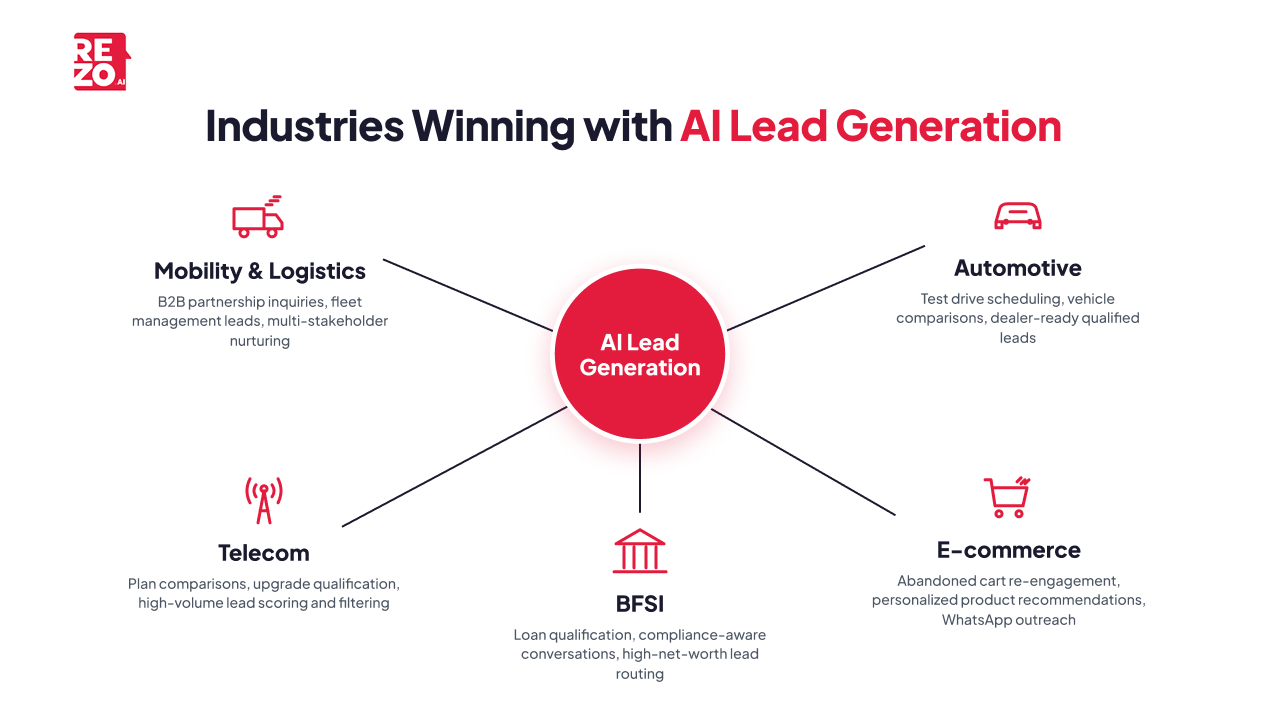
The impact of conversational AI for lead generation spans industries, but several sectors are seeing particularly strong results from AI lead generation.
BFSI (Banking, Financial Services, and Insurance). AI agents qualify prospects for loans, credit cards, and insurance products through compliant, conversational interactions. AI lead generation tools handle regulatory disclosure requirements naturally and route high-net-worth leads to specialized advisors with full context. Predictive analytics and AI tools help identify the most promising leads based on financial behavior. For a deeper look at AI's role in financial services, explore our guide on AI in banking customer service.
- Automotive and OEMs. Dealership inquiries, test drive scheduling, and service upsell conversations are perfectly suited for AI lead generation. Prospects get instant responses to vehicle comparison questions, and dealers receive qualified leads that are ready to convert. AI powered tools help marketing teams target audience segments with personalized outreach.
- E-commerce and Consumer Durables. Abandoned cart re-engagement is a massive opportunity here. Ai agents reach out via WhatsApp, web chat, or social channels with personalized recommendations based on browsing history and customer preferences, turning window shoppers into paying customers and generating leads from traffic that would otherwise bounce.
- Telecom. With high-volume inbound traffic, telecom companies use AI lead generation tools to handle plan comparison inquiries, automate lead scoring for upgrade candidates, and filter signal from noise so sales teams focus on the prospects most likely to convert. Predictive analytics and data analysis help prioritize leads based on usage patterns and lead behavior.
- Mobility and Logistics. B2B partnerships, fleet management inquiries, and service onboarding conversations involve multiple decision-makers and longer sales cycles. AI agents keep potential leads engaged and qualified throughout the journey, nurturing future customers across every touchpoint.
Gartner reports that 85% of customer service leaders are exploring or piloting generative AI solutions, while Deloitte found that 48% of companies with mature service operations already use AI agents. The early movers are setting the standard for ai powered lead generation across industries, and their marketing efforts are producing measurably better results.
How to Implement Conversational AI for Lead Generation
Rolling out conversational AI does not require a year-long transformation program. Here is a practical, phased approach that enterprise marketing and sales teams can follow to transform their lead generation process.
Phase 1: Audit and Define (Weeks 1 to 2)
Start by mapping your current lead generation process end to end. Where are potential leads dropping off? Where do sales leads go cold? Define key metrics and clear KPIs: lead volume, qualification accuracy, response time, and conversion rates. Analyze your target audience segments and identify which parts of the sales funnel have the biggest gaps. Then pick two to three high-impact use cases to target first. Do not try to solve everything at once.
Phase 2: Design and Build (Weeks 3 to 5)
Design conversation flows that mirror how your best sales reps actually engage prospects. Configure AI-to-human handoff triggers based on the escalation criteria identified in Phase 1. Integrate with your existing systems, including CRM and marketing automation platforms, so data flows automatically between AI tools and your sales process. Set up omnichannel deployment across your priority channels. Select AI lead generation tools that support lead scoring, predictive lead scoring, and automating lead qualification out of the box. This is also where you build lead gen flows for specific target audience segments.
Phase 3: Launch and Learn (Weeks 6 to 8)
Run a controlled pilot with a clearly defined prospect segment. Monitor conversation quality, conversion rates, lead quality, and user feedback daily. Track how effectively your AI tools are generating leads and whether qualified leads are converting at higher rates. Resist the temptation to scale prematurely. Instead, iterate based on real data, use data analysis to identify what is working, and refine your conversation flows before expanding.
Phase 4: Scale and Optimize (Ongoing)
Expand to additional channels and use cases based on pilot learnings. Use predictive analytics and AI analytics to continuously refine lead scoring criteria. A/B test conversation approaches and measure their impact on pipeline velocity. Integrating AI tools across more touchpoints increases the volume of high quality leads entering your sales funnel. Integrating AI powered lead generation into your broader marketing efforts compounds results over time. Data driven decision making is what separates teams that see incremental gains from those that achieve transformational results.

What Does the Future Hold for AI-Powered Lead Generation?
The trajectory is clear, and it is accelerating.
Agentic AI agents will take center stage. We are moving from reactive chatbots to autonomous AI agents capable of managing entire lead lifecycles, from initial identification through lead scoring, qualification, nurturing, and handoff, without human intervention for routine interactions. These AI agents will automate lead scoring across the entire sales funnel and enable marketing teams to focus their marketing efforts on high quality leads.
Voice-first lead generation is poised to rival digital channels in automation sophistication. Phone-based prospecting, long considered resistant to artificial intelligence, is being transformed by voice bots that sound natural and handle complex qualification conversations. AI technology is making it possible for AI agents to conduct entire sales conversations by phone, converting potential customers into qualified leads.
Predictive lead generation will enable AI algorithms to identify high-intent prospects before they even reach your website, using predictive analytics, lead behavior signals, firmographic data, and market indicators to proactively initiate outreach. By analyzing customer data and identifying patterns in how potential leads behave, artificial intelligence will surface the sales leads your team should prioritize.
Hyper-personalization will go beyond what is said to include how it is communicated. AI powered tools will adapt tone, pacing, channel preference, and conversation depth based on individual prospect profiles and customer preferences, delivering marketing messages that feel genuinely relevant. The result: improved lead quality and stronger customer relationships from the very first interaction.
Enterprise-grade compliance will become a core feature, not an afterthought. GDPR, CCPA, and industry-specific regulations will be built into ai lead generation software from the ground up, ensuring customer satisfaction and trust at every step of the lead generation process.
Gartner reports that 98% of organizations have integrated or plan to integrate AI into their customer engagement strategies. Deloitte finds that 66% of companies already report measurable productivity gains from AI adoption. The question is no longer whether to adopt conversational AI for lead generation. It is how quickly you can do it well.
Getting Started
Lead generation is moving from static forms and cold calls to intelligent, always-on conversations powered by AI lead generation tools. Every day you wait, prospects are engaging with competitors who respond faster, qualify smarter, and personalize better.
The good news? You do not need to overhaul everything overnight. Start small with one or two high-impact use cases, measure results rigorously, and scale based on what the data tells you. Even modest lead generation efforts powered by ai technology deliver measurable improvements in lead quality, engagement and conversion rates, and customer satisfaction.
Choosing the right partner makes all the difference. The right platform turns conversational AI into a transformative pipeline engine, not just another chatbot experiment. Look for enterprise-grade AI lead generation tools with proven industry expertise and a team that understands your specific lead generation challenges. The best lead generation software integrates seamlessly with existing systems, supports your sales process end to end, and helps both marketing and sales teams convert potential leads into paying customers.
Your prospects are already talking. It is time to start listening, and responding, intelligently.
Frequently Asked Questions
Can conversational AI replace my sales team?
No. Conversational AI augments your sales teams by automating repetitive tasks like initial engagement, FAQ responses, and lead qualification. Ai agents handle lead scoring, data analysis, and initial outreach, freeing reps to focus on building customer relationships and closing deals, saving marketing and sales teams 4 to 7 hours weekly. AI technology assists your team; it does not replace the human judgment needed for complex sales.
How do you measure the success of a lead generation chatbot?
Track lead conversion rate, cost per lead, engagement and conversion rates, and average session duration. Compare customer acquisition cost before and after deployment, monitor conversation drop-off points, and measure lead quality through sales qualified leads ratios. Key metrics to watch include how effectively your ai tools are generating leads, the percentage of high quality leads in your pipeline, and whether your overall lead generation efforts are translating into revenue.
Frequently Asked Questions (FAQs)


Take the leap towards innovation with Rezo.ai
Get started now