How Conversational AI for Retail Is Changing CX?

How Conversational AI for Retail Is Changing CX?
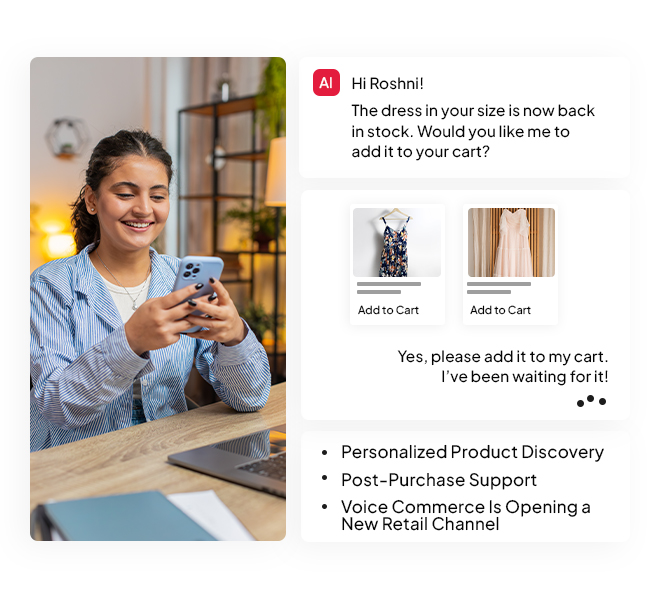


Retail has always been a relationship business. But the way customers want to build those relationships has fundamentally changed. Today's shoppers expect instant answers, personalized conversations, and seamless service across every channel they touch. Most retail contact centers, still leaning on rule-based chatbots and overloaded human agents, simply cannot keep up. That is exactly why conversational AI in retail has moved from a "nice to have" to a strategic imperative. McKinsey estimates that generative AI could unlock up to $310 billion in additional value for the retail business alone. The opportunity is massive, but only for those who act with clarity and speed.
Why Retail Customer Experience Needs a Reset?
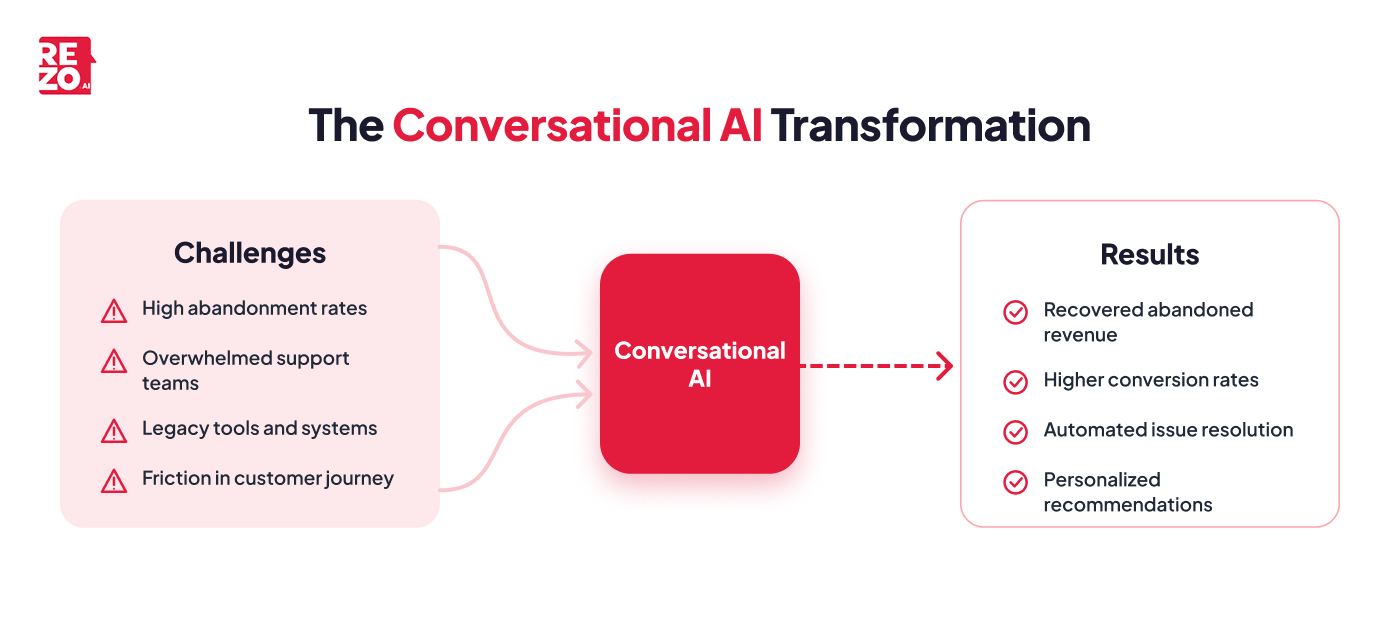
Consider this: 70% of online shopping carts are abandoned before checkout. Most of those losses are preventable. Customers leave because they cannot find answers fast enough, feel overwhelmed by choices, or encounter friction that a well-timed conversation could resolve. Meanwhile, contact centers handling over 150,000 monthly customer interactions are stretched thin, relying on legacy systems and legacy tools that treat every customer the same.
Consumer expectations have shifted dramatically. Customer expectations now center on the speed of self-service combined with the empathy of a knowledgeable in-store associate. Shoppers want help on WhatsApp and other messaging platforms at 11 PM, not just during business hours. And they expect every interaction to pick up where the last one left off, regardless of channel. This gap between customer expectations and current retail capabilities is reshaping the entire customer journey.
Gartner predicts that by 2029, agentic AI agents will autonomously resolve 80% of common customer service issues without human intervention. That is not a distant aspiration. It is a trajectory already underway, and retail brands who wait will find themselves playing catch-up against competitors who invested early in ai adoption.
What Makes Conversational AI Different from Traditional Chatbots?
This is a question worth answering clearly, because the distinction matters more than most people realize.
Conversational AI uses natural language processing, natural language understanding, machine learning, and large language models to understand customer intent and deliver personalized, context-aware responses across chat, voice assistants, and messaging channels. Unlike rule-based chatbots, advanced ai systems learn from user interactions and can autonomously execute routine tasks like processing returns or recommending products through personalized product suggestions. If you are exploring how this technology works across industries, this complete guide to conversational AI for customer service breaks it down further. Understanding how conversational AI works is essential for any retail business evaluating ai adoption.
The evolution has been rapid. Rule-based bots (2015 to 2018) followed rigid scripts. NLP-powered ai assistants (2019 to 2022) understood basic intent. LLM-driven conversational AI (2023 to 2025) brought contextual understanding and natural dialogue. Now, agentic AI agents (2025 and beyond) can independently handle multi-step tasks: initiating a return, applying a promotional discount, and scheduling a replacement delivery, all within a single conversation and without a human stepping in. These ai agents represent the next generation of artificial intelligence in retail, capable of human like interactions that reshape the shopping experience.
Research says more than half of organizations already use ai powered chatbots or conversational AI for customer-facing roles. The distinction is no longer academic. It is operational.
How Conversational AI Is Transforming the Retail Experience?
Rather than listing a dozen surface-level use cases, let us focus on four high-impact areas where conversational AI in retail is already delivering measurable results and driving customer satisfaction across the entire customer journey.
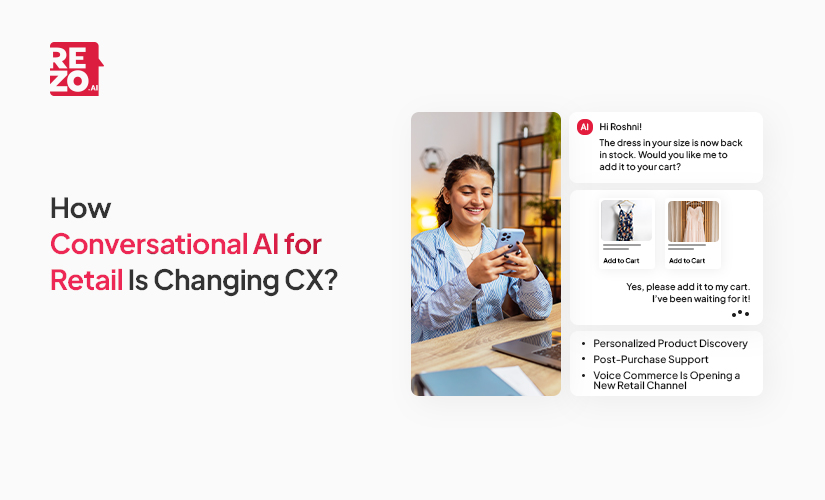
Personalized Product Discovery That Actually Converts
The best retail conversational AI does not just answer questions. It uses ai powered tools to guide customers toward the right product through natural conversation, much like a skilled in-store associate would.
The numbers back this up. Personalized recommendations and tailored recommendations now account for up to 31% of conversational commerce revenue. Shoppers who engage with ai powered retail assistants convert at 12.3%, compared to just 3.1% for those who do not. That is a 4x improvement in conversion, and it happens because the customer feels understood rather than marketed to. AI-driven interactions like these enhance customer experience and drive sales by meeting customer preferences in real time. For a deeper look at how AI automation is reshaping customer service strategy, including personalization at scale, that guide is worth a read.
Why Cart Abandonment Is Finally a Solvable Problem?
With 70% of online carts abandoned, this has long been the retail sector's most persistent leak. Traditional approaches like retargeting emails sent hours later are too slow and too generic. Conversational AI changes the equation by intervening in real time, transforming the online shopping experience.
Instead of blasting a generic discount popup, ai powered assistants trigger context-aware nudges based on browsing behavior, cart value, customer behavior, and session duration. A shopper hesitating on a high-value item might receive a message addressing the specific concern likely causing friction, whether that is sizing, shipping time, or return policy clarity. Proactive conversational commerce recovers up to 35% of abandoned carts, and 49% of consumers report making impulse purchases after AI-driven suggestions. These interventions work across WhatsApp, web chat, messaging platforms, and SMS, meeting the customer wherever they are on their shopping journey. Ai tools that analyze customer data and customer behavior in real time are what make this possible.
Post-Purchase Support That Builds Loyalty
Order tracking, returns, exchanges, and the ubiquitous "Where Is My Order?" (WISMO) queries represent the highest-volume customer interactions in most retail contact centers. These are exactly the interactions where conversational AI and ai agents deliver exceptional customer satisfaction.
Businesses looking to understand how ai powered chatbots can improve customer engagement will find that post sale support automation is one of the strongest use cases.
For enterprises managing 150,000 or more monthly interactions, automating these high-volume queries with ai agents frees human agents to focus on complex, high-value personalized conversations where empathy and judgment matter most. This is how conversational AI works at scale: streamlining operations while improving overall business performance and customer satisfaction.
How Voice Commerce Is Opening a New Retail Channel
Voice is the next frontier for conversational commerce in retail. The global voice commerce market stands at $42.75 billion in 2023 and is projected to reach $186.28 billion by 2030, growing at a 24.6% CAGR. That trajectory signals a fundamental shift in how consumers interact with retail brands through voice assistants and ai agents.
Voice AI also extends into in-store kiosks, phone-based customer service, and smart home devices, creating an omnichannel orchestration layer that most retailers in the retail landscape have barely begun to explore. These ai powered voice agents connect customer data from the customer journey across messaging platforms and in-store touchpoints. To understand how AI voice agents work and where they are headed, this overview covers the fundamentals.
What Leading Retailers Get Right About Implementation?
Understanding the use cases is one thing. Knowing how to implement conversational AI in retail without disruption or disappointment is another. Here is a practical, phase-based framework that leading retailers follow for successful ai implementation.
Phase 1: Start with High-Volume, Low-Complexity Queries
Begin where the impact is immediate and the risk is low. FAQ automation, order tracking, and basic account inquiries typically represent 40% to 60% of contact center volume and are the easiest to automate with high accuracy using ai powered chatbots.
Integrate conversational AI with your existing systems, including your CRM and order management platform. This is not about ripping and replacing your tech stack. It is about layering intelligence on top of what you already have. Set baseline metrics from day one: containment rate, CSAT, average handle time, and first-contact resolution. These KPIs will guide every subsequent phase and help you optimize performance over time.
Phase 2: Add Personalization and Proactive Engagement
Once the foundation is stable, layer in personalized product suggestions, cart recovery, and personalized upselling through conversational commerce. This requires connecting your conversational AI to first-party customer data, including purchase history, browsing behavior, and loyalty status. Integration with your CDP, CRM, product catalog, and inventory management systems is essential at this stage. Machine learning and continuous training on customer interactions ensure the ai models improve with every conversation.
Salesforce reports that 92% of retailers are increasing investment in conversational AI and ai tools. The competitive advantage is shifting from "having AI" to "having AI that knows your customer" and can deliver personalized customer experiences at every touchpoint in the shopping journey.
Phase 3: Scale Across Channels and Go Agentic
Expand from web chat to WhatsApp, voice assistants, in-store kiosks, and social messaging platforms. The key differentiator at this stage is maintaining conversation context across channels. A customer who starts a query on WhatsApp and continues by phone should never have to repeat themselves. This kind of seamless customer engagement across the shopping experience is what builds brand loyalty.
This is also when agentic ai agents enter the picture. Move toward autonomous task execution: processing returns, applying promotions, and scheduling deliveries without human handoff. Gartner predicts that by the end of 2026, 40% of enterprise applications will include task-specific ai agents. Design clear escalation pathways for complex or emotionally sensitive interactions. The balance between human agents and ai powered systems is what separates good ai implementation from great. For a closer look at the latest contact center automation trends, this resource covers what is shaping CX in 2026.

What to Watch Out For
Brand voice consistency is non-negotiable. Train your ai systems on your specific tone guidelines, not generic templates. Customers notice when the AI "sounds" different from the brand they know. Sentiment analysis can help ai agents detect when conversations shift in tone and adjust accordingly.
Data privacy and compliance deserve serious attention. Address GDPR, data privacy regulations, data minimization, and responsible AI practices from the start. Enterprise buyers increasingly evaluate vendors on this criterion, and customers are more data-aware than ever. How you handle customer data directly impacts customer satisfaction and brand loyalty.
Human escalation design is often an afterthought, but it should not be. Define when and how AI hands off to human agents. Not every interaction should be automated. Some moments, like a frustrated long-time customer or a sensitive complaint, require human like interactions and a human touch. The best ai implementation frameworks ensure human agents handle what they do best while ai agents manage routine tasks and drive sales through conversational commerce.
Where Conversational AI in Retail Is Headed Next?
The trajectory is clear, and it is accelerating. Ai agents will evolve from resolving queries to anticipating needs. Think predictive shopping concierges that proactively suggest replenishment orders based on past purchases and usage patterns, or virtual assistants that prepare outfit recommendations ahead of a seasonal change. These advanced ai capabilities will reshape the entire customer journey.
Multimodal AI will combine text, voice, and visual search tools for richer in-store and online retail experiences. Virtual try-ons and AR-powered product previews are already here; soon, they will be natively integrated into conversational flows, creating personalized customer experiences that enhance customer engagement across the retail sector.
The numbers tell the story of momentum. Consumer spending through conversational commerce reached $290 billion in 2025, up from just $41 billion in 2021. Gartner projects that agentic ai agents will lead to a 30% reduction in operational costs by 2029, delivering significant operational efficiency and improved business performance. These are not speculative projections. They are extensions of trends already in motion, and they reflect growing ai adoption across the retail landscape.
The retailers who invest now in conversational AI infrastructure and ai tools will hold a compounding advantage as agentic capabilities mature, streamlining operations and transforming the shopping experience for years to come.
The Bottom Line
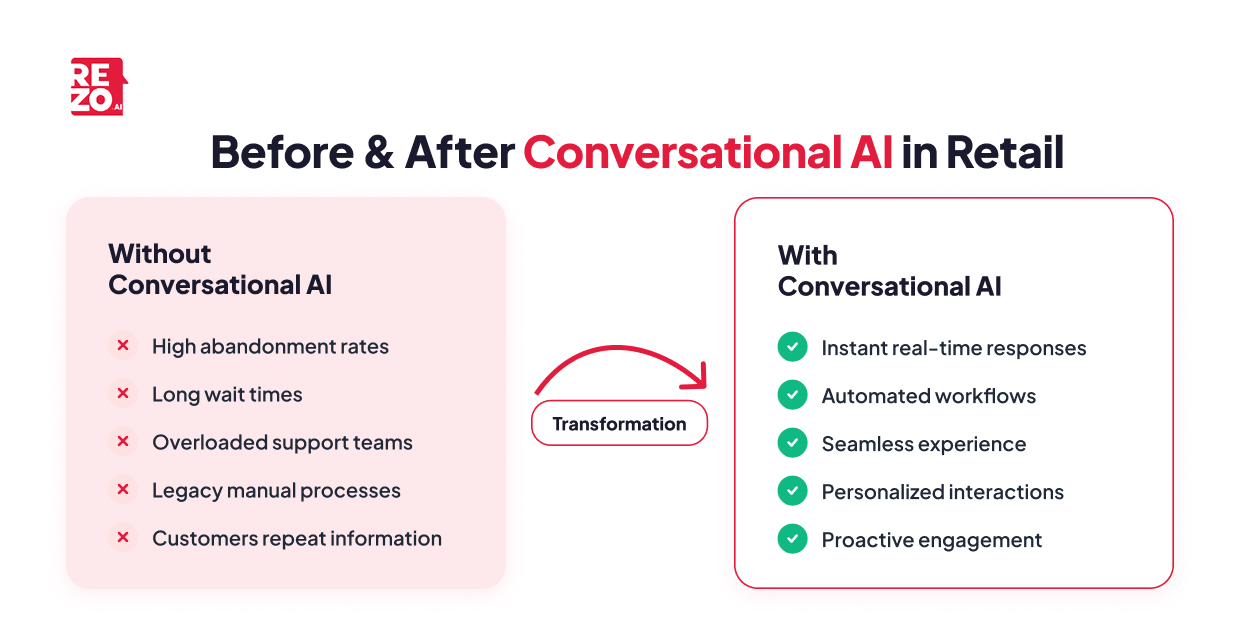
Conversational AI in retail is no longer experimental. It is operational infrastructure for modern customer experience. From personalized product discovery to voice commerce, from cart recovery to autonomous post purchase support, the technology is delivering measurable impact for retail brands willing to implement it thoughtfully.
The question for retail leaders is not whether to adopt conversational AI, but how quickly they can move from pilot to scale. Start with high-volume queries, build toward personalization, and design for the agentic future that is already taking shape. With the right ai implementation strategy, retailers can enhance customer experience, drive sales, and deliver the customer satisfaction that builds lasting brand loyalty.
If your contact center is handling thousands of customer interactions daily with existing systems that were built for a different era, the framework above offers a clear path forward. The retailers who move now will define what great CX looks like in the years ahead.
Frequently Asked Questions
How does conversational AI improve the retail shopping experience?
Conversational AI delivers personalized product suggestions, real-time support, and seamless service across messaging platforms like WhatsApp and voice assistants. It understands customer intent and context, helping guide customers to products faster and resolving queries instantly through ai driven interactions, leading to higher customer satisfaction and conversions across the entire shopping experience.
Is conversational AI better than live chat for retail?
Conversational AI and live chat work best together. Ai powered chatbots handle high-volume, routine tasks instantly at scale, reducing support costs by up to 30% and improving operational efficiency. Live chat excels for sensitive or complex issues requiring human agents. The strongest retail strategies combine both for speed and empathy, maximizing customer engagement across the customer journey.
Frequently Asked Questions (FAQs)


Take the leap towards innovation with Rezo.ai
Get started now