5 Reasons Why Your Business Needs Conversational AI Chatbots

5 Reasons Why Your Business Needs Conversational AI Chatbots



Picture this: a customer reaches out at 2 AM with an urgent query about their insurance claim. Instead of waiting until traditional business hours, they get an instant, personalized response that resolves their issue on the spot. This is the power of a conversational AI chatbot, and it is transforming how enterprises connect with their customers through more meaningful customer interactions.
As customer expectations soar and interaction volumes multiply, businesses are discovering that traditional chatbots simply cannot keep up. According to Gartner, 85% of customer service leaders plan to explore or pilot conversational AI solutions in 2025. The question is no longer whether to adopt these AI technologies, but how to do it right.
What Is a Conversational AI Chatbot?
A conversational AI chatbot is an intelligent virtual assistant that uses advanced AI technologies like natural language processing (NLP), natural language understanding (NLU), and machine learning to engage in human-like conversations. Unlike traditional rule-based chatbots that follow predefined scripts, these AI-powered chatbots can understand context, recognize customer intent, and adapt their responses dynamically.
Think of it this way: a traditional chatbot is like a vending machine with preset buttons, while a conversational AI chatbot is more like a knowledgeable assistant who listens, understands, and responds appropriately to simulate human conversation.
The technology stack powering these AI agents includes natural language processing for handling human language in text and speech, natural language understanding for interpreting meaning and intent, sentiment analysis for detecting emotions, and machine learning algorithms that enable the system to improve with every interaction.
Why Are Businesses Moving to Conversational AI Chatbots?
The shift toward AI chatbots is driven by a perfect storm of customer expectations and operational challenges that traditional solutions cannot address.
Today's customers expect instant responses, regardless of when they reach out or which channel they use. They want personalized customer interactions that remember their history and preferences. Meeting these expectations with human agents alone would require massive investments in staffing, training, and infrastructure across contact centers worldwide.
Volume management has become a critical concern. Enterprises handling hundreds of thousands of monthly customer interactions face constant pressure during peak periods, seasonal spikes, and unexpected surges. AI chatbots and virtual agents can manage these fluctuations without requiring proportional increases in headcount.
The omnichannel imperative adds another layer of complexity. Customers now interact across Voice, Chat, Email, and WhatsApp, often switching between channels mid-conversation. They expect seamless continuity regardless of where the conversation happens. AI-powered platforms can orchestrate these customer interactions under a unified system, maintaining context across every touchpoint. For a deeper dive into omnichannel strategies, explore our guide to omnichannel contact centers.
McKinseyreports that 78% of companies have already integrated AI technologies into at least one key operational area, with most seeing steady returns and improved efficiency. The market itself is projected to reach $41.39 billion by 2030, reflecting the widespread recognition of its value for customer engagement.
How Does a Conversational AI Chatbot Work?
Understanding how AI chatbots work helps demystify the technology and reveals why they outperform traditional alternatives in delivering accurate responses.
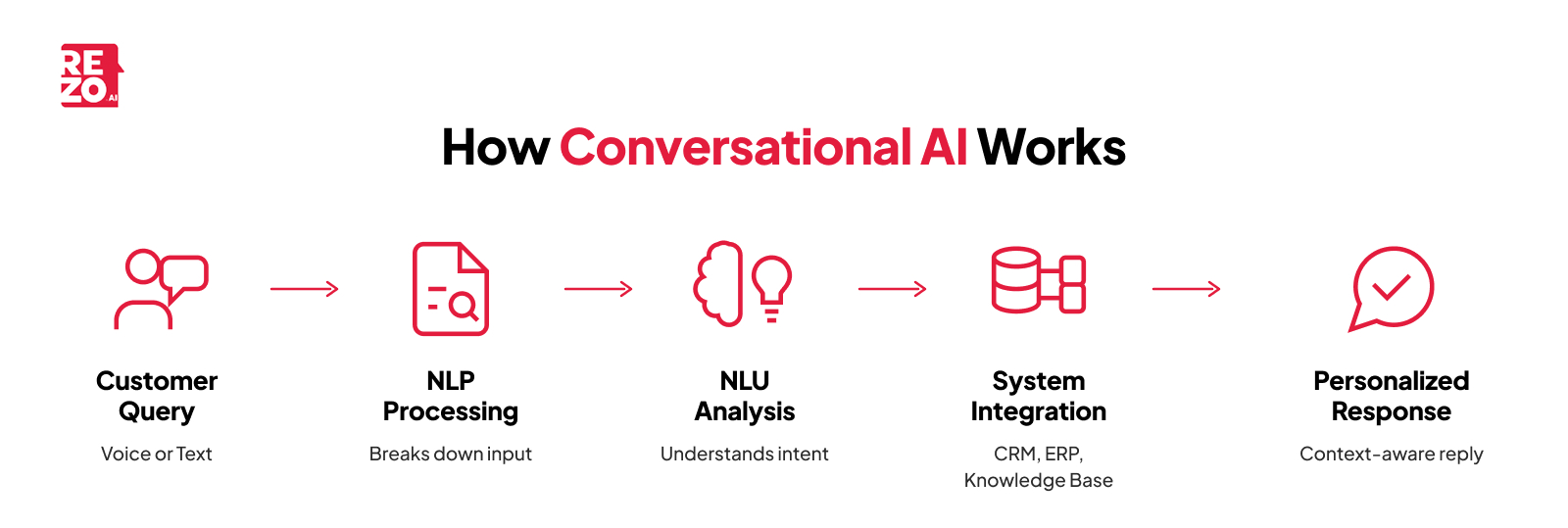
When a customer sends a message or speaks a query, the system first processes the user's input through natural language processing. This breaks down the text or speech into components the system can analyze, handling variations in phrasing, slang, and even grammatical errors that would confuse simpler systems relying on predefined scripts.
Next, natural language understanding kicks in to interpret the meaning behind the words. The AI model identifies the customer's intent, whether they want to check an order status, resolve a complaint, or answer frequently asked questions. It also extracts key entities like account numbers, product names, or dates to provide relevant responses.
The system then formulates a response by drawing on its knowledge base, past interactions, and integrations with backend systems like CRM, ERP, or ticketing platforms. This allows it to provide personalized, contextually relevant responses rather than generic answers to user queries.
Throughout this process, AI agents retain context across the conversation. If a customer mentions their account number at the start, the system remembers it without asking again. This context retention extends across sessions, enabling truly personalized experiences over time and improving the overall customer journey.
The Role of Machine Learning and Generative AI
Machine learning is what gives these virtual agents their ability to improve continuously. Every customer interaction becomes a learning opportunity. The system identifies patterns in successful resolutions, recognizes common query types, and refines response quality based on outcomes.
Unlike traditional chatbots that require manual updates whenever you want to change a response, AI-powered chatbots adapt automatically. When new products launch or policies change, the system can incorporate this information from connected data sources without extensive reprogramming.
Generative AI and large language models are further advancing these capabilities, enabling more natural language conversations and human-like interactions. These AI technologies allow virtual agents to handle complex queries and generate contextually appropriate responses that feel like genuine human conversation.
What Benefits Can You Expect from Conversational AI Chatbots?
The benefits of implementing AI chatbots extend across customer experience, business processes, and employee satisfaction.
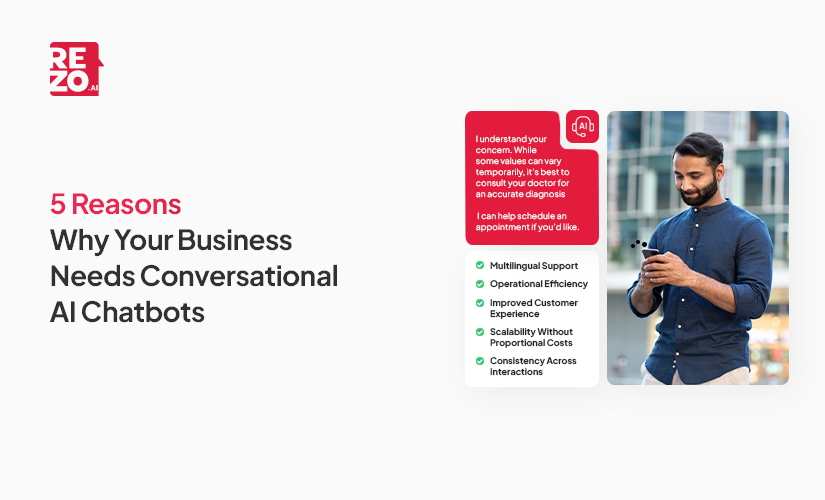
- Improved Customer Experience and Engagement: Customers receive instant responses at any hour, eliminating frustrating wait times outside traditional business hours. The personalization capabilities mean customer interactions feel tailored rather than transactional. Research shows that customer satisfaction increases significantly when businesses deliver this level of service as standard.
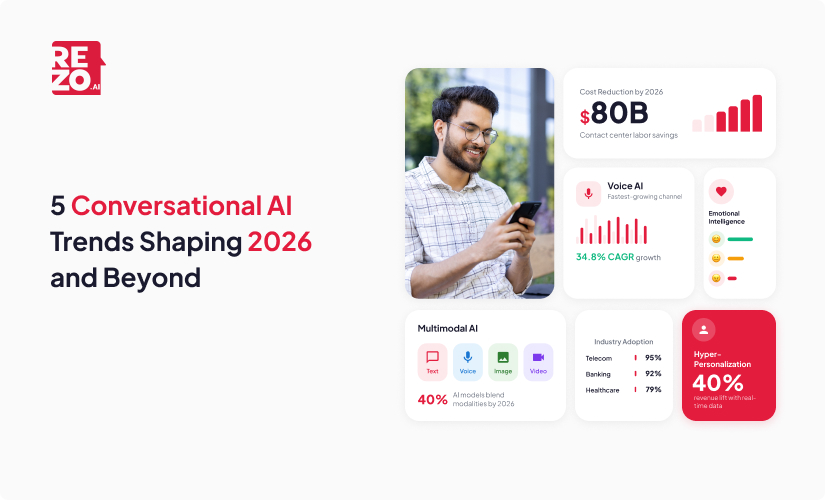
- Enhanced Contact Center Performance: By handling routine tasks and customer queries autonomously, AI agents significantly reduce Average Handle Time and increase deflection rates in contact centers. Gartnerestimates that AI integration in contact centers could cut agent labor costs by $80 billion by 2026.
- Scalability Without Proportional Costs: Whether you handle 10,000 or 100,000 customer interactions monthly, AI chatbots and virtual agents scale to meet demand without requiring equivalent increases in staffing. This makes them ideal for enterprises with fluctuating volumes or rapid growth. Our guide on AI for scaling in contact centers explores this in depth.
- Consistency Across Customer Interactions: Human agents vary in expertise and training, leading to inconsistent customer experiences. AI chatbots deliver uniform response quality by pulling from a single source of truth for every interaction.
- Multilingual Customer Support: Serving customers across regions becomes straightforward when your AI-powered chatbots can communicate in multiple languages without hiring specialized agents for each market, expanding customer engagement globally.
Enhancing the Agent Experience
A crucial but often overlooked benefit is the positive impact on your support teams and human agents. Industry reports say that 81% of support leaders believe automated customer support tools improve the employee experience and reduce attrition.
When AI agents handle repetitive customer queries and routine tasks, human agents can focus on complex tasks that require empathy, judgment, and creative problem-solving. This shift transforms the agent role from routine query handler to skilled problem solver, increasing job satisfaction and reducing burnout.
The goal is not to replace human agents but to augment their capabilities. AI chatbots and human agents work together, with virtual agents handling volume while humans handle more complex tasks requiring nuanced human interactions.
How to Implement a Conversational AI Chatbot
Successful implementation requires a structured approach that balances technology considerations with organizational readiness.
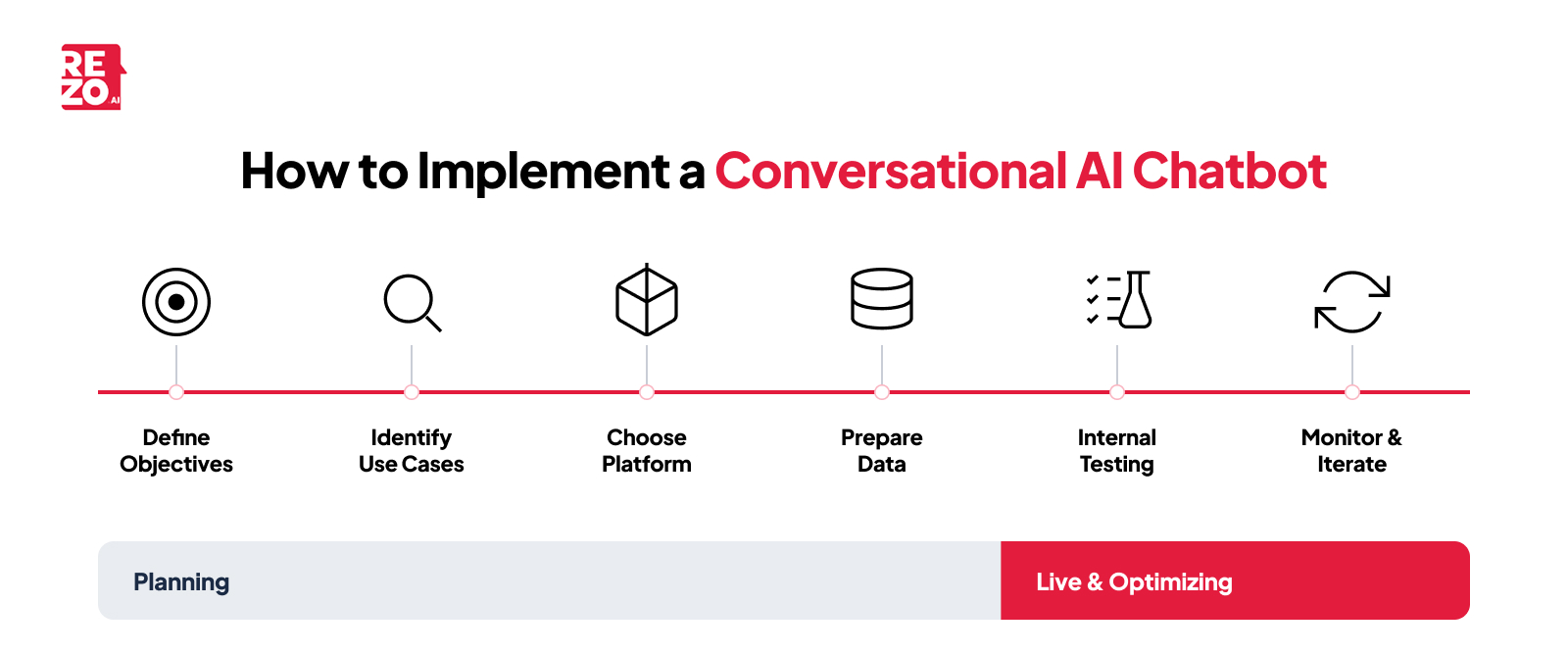
Step 1: Define Clear Objectives and KPIs
Start by identifying what you want to achieve. Is it reducing response times? Improving customer satisfaction scores? Streamlining business processes? Set measurable KPIs like deflection rate, first response time, resolution accuracy, or cost per contact to track success.
Step 2: Identify High-Impact Use Cases
Rather than attempting enterprise-wide deployment immediately, start with 2-3 well-defined use cases where AI chatbots can deliver rapid value. Common starting points include FAQ handling to answer user queries, order status inquiries, or appointment scheduling, areas where virtual agents excel.
Step 3: Choose the Right AI Platform
Evaluate business tools and platforms based on integration capabilities with your existing systems, omnichannel support, security and compliance features, and scalability for enterprise needs. The platform should work seamlessly with your CRM, ticketing system, and communication channels across contact centers.
Step 4: Prepare Quality Data and Content
AI chatbots are only as good as the data they learn from. Gather and refine existing resources like FAQs, support scripts, and knowledge base articles. Conduct conversation simulations to identify gaps in how the system will process human language and respond to potential customers.
Step 5: Test Internally Before Customer Rollout
Launch internally first to complete user and security testing. Work out necessary fixes before exposing the system to customers. This phased approach reduces risk and builds confidence in the AI model's ability to handle real customer requests.
Step 6: Monitor, Analyze, and Iterate
Post-launch, regularly analyze conversation logs to identify failure points and improve response quality. Review queries that required human escalation. Periodically retrain with new data to expand capabilities and ensure the system continues to respond appropriately to evolving customer needs.
Selecting the Right Platform
When choosing an AI-powered platform for your contact centers, prioritize:
- Integration: Seamless connection with CRM, ERP, and ticketing systems
- Omnichannel: Unified management of Voice, Chat, Email, WhatsApp, and social media platforms
- Security: Compliance with regulations like GDPR and industry standards
- Scalability: Ability to handle your current and projected volumes across all conversational interfaces
Which Industries Benefit Most from Conversational AI Chatbots?
While AI chatbots deliver value across sectors, certain industries see particularly strong returns from these conversational AI applications.
BFSI (Banking, Financial Services, Insurance): From collections and lending inquiries to insurance claims processing, AI agents handle high volumes of structured customer interactions efficiently while maintaining compliance. Virtual agents in this sector can answer questions about account balances, process customer requests, and guide users through the customer journey.
Automotive: Dealer networks use AI chatbots for service scheduling, parts inquiries, and customer follow-ups, improving both customer satisfaction and streamlining business processes.
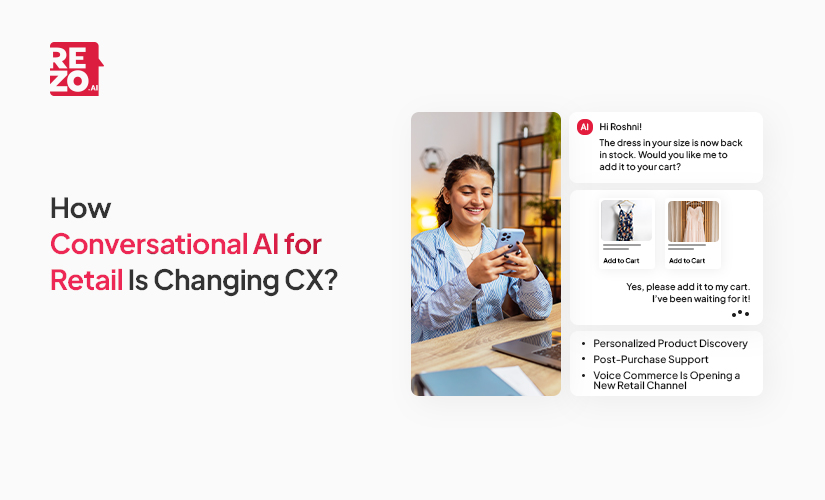
E-commerce and Retail: Order tracking, returns processing, and product recommendations become seamless with AI-powered chatbots, enhancing the shopping experience and customer engagement for both existing and potential customers.
Telecom: Plan inquiries, billing questions, and technical troubleshooting are natural fits for AI agent capabilities in high-volume contact centers.
Healthcare: Appointment booking, prescription refills, and symptom-based triage benefit from the 24/7 availability and consistent responses that AI chatbots provide, ensuring customer assistance is always available.
The Future of Conversational AI Chatbots
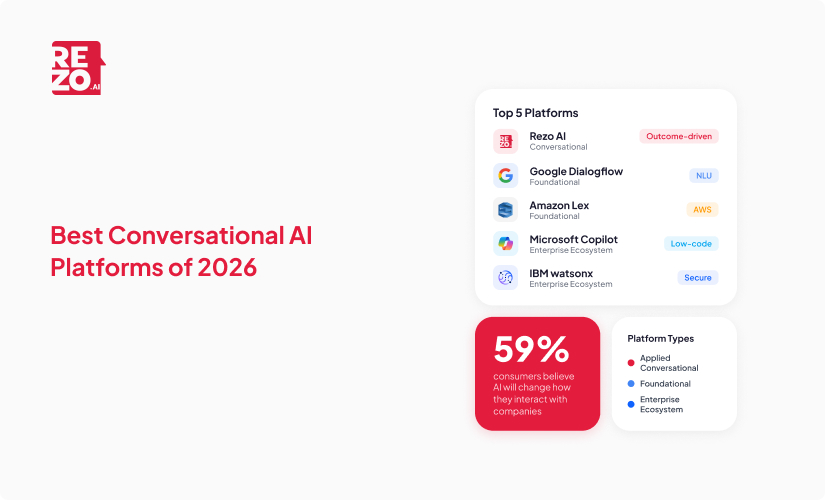
The trajectory of AI technologies points toward even greater autonomy and capability. Gartner predicts that by 2029, agentic AI combined with conversational AI will autonomously resolve 80% of common customer service issues without human intervention.
Voice-first conversational interfaces are becoming increasingly dominant as voice AI technology matures. Enterprises that integrate AI voice agents alongside chat will be positioned to meet customers wherever they prefer to engage, whether on mobile devices or other channels.
Deeper enterprise integration will blur the lines between AI agents and core business systems. Instead of simply answering questions, generative AI and virtual agents will increasingly take actions: processing refunds, updating accounts, scheduling appointments all within the natural language flow of conversation.
The businesses that embrace AI chatbots today are not just solving current challenges. They are building the foundation for customer experience excellence and enhanced customer engagement in the years ahead.
Frequently Asked Questions
Can a conversational AI chatbot handle multiple languages simultaneously?
Yes. Modern AI chatbots can detect and respond in multiple languages within the same conversation, automatically switching based on user's input without requiring separate deployments for each language enabling seamless customer support globally.
How long does it take to train a conversational AI chatbot?
Initial training typically takes 2-4 weeks depending on data quality and use case complexity. However, these AI agents continuously learn from past conversations and customer interactions, so performance improves progressively after deployment through machine learning and deep learning capabilities.
Is conversational AI secure enough for handling sensitive customer data?
Enterprise-grade AI platforms offer encryption, compliance certifications (SOC 2, GDPR, HIPAA), and data governance controls. Security depends on choosing the right platform with appropriate certifications for your industry, ensuring your support teams and customers can trust the system with sensitive information.
Frequently Asked Questions (FAQs)


Take the leap towards innovation with Rezo.ai
Get started now