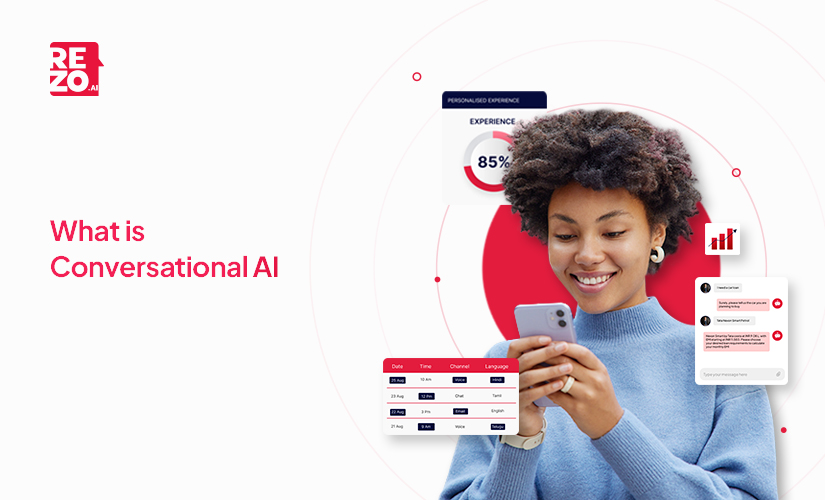
What is Conversational AI

What is Conversational AI
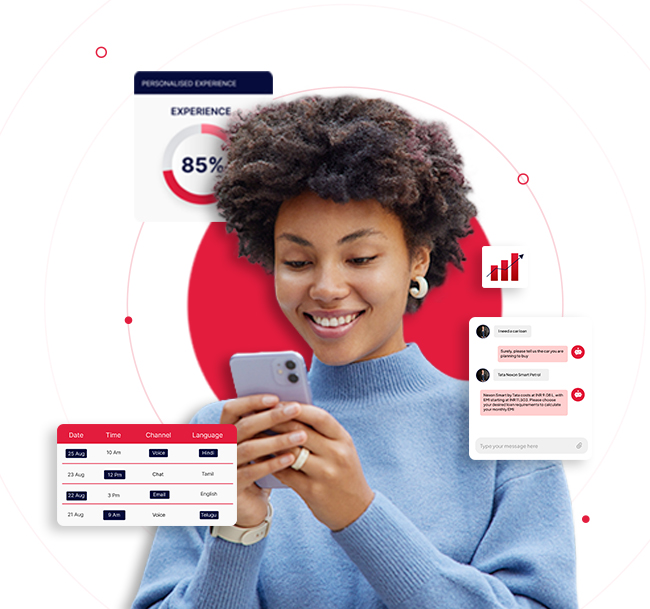


Picture this: it is 11:47 PM, and one of your customers discovers an unauthorized charge on their credit card. They reach out through your contact center, and within seconds, a voice on the other end understands the urgency, verifies their identity, flags the transaction, and initiates a dispute. No hold music. No "please call back during business hours." That is conversational AI at work. And if you are wondering what is conversational AI and how it fits into your enterprise strategy, you are asking the right question at the right time.
What Exactly is Conversational AI (And Why Should You Care)?
In simple terms, conversational artificial intelligence is technology that enables machines to understand, process, and respond to human language naturally, across both voice and text channels. But here is what separates conversational AI technology from the rule-based chatbots you may have encountered (and been frustrated by): conversational AI does not just match keywords. It grasps user intent, reads context, and holds meaningful, multi-turn conversations that simulate human conversation going far beyond scripted exchanges to mirror the natural rhythm of human conversation. What makes conversational AI distinct is its ability to process human language in all its complexity and respond appropriately, delivering human like responses that feel genuinely natural.
The market agrees that this matters. According to MarketsandMarkets, the conversational AI market is valued at USD 17.05 billion in 2025 and is projected to reach USD 49.80 billion by 2031, growing at a 19.6% CAGR. Yet the adoption gap is striking: Accenture's artificial intelligence research reveals that while 97% of executives say AI will transform their industry, only 9% have fully deployed an AI use case. The opportunity for enterprises adopting conversational AI now is enormous.
How Does Conversational AI Actually Work?
Understanding how conversational AI works does not require a computer science degree. At its core, this conversational AI technology relies on four interconnected components working together in real time combining natural language processing, machine learning, deep learning, and dialogue management to understand human language and respond to human language with remarkable accuracy.
Natural Language Processing (NLP) is the foundation. Natural language processing NLP serves as the first step when a customer says, "I think someone used my card." NLP breaks that sentence apart, identifying the structure, key phrases, and linguistic patterns. Think of it as the AI system's ability to read and interpret human speech and user input.
Natural Language Understanding (NLU) goes a step deeper. Natural language understanding NLU figures out what the customer actually means by understanding user intent behind their words. In this case, the intent is not a general account inquiry; it is a potential fraud report with urgency behind it. NLU captures context, sentiment, and the nuances that separate a casual question from a critical issue.
Natural Language Generation (NLG) is how the system crafts its response. Unlike rigid templates, natural language generation goes beyond pulling a canned reply from a script natural language generation NLG produces relevant responses that are naturally worded: "I understand this is concerning. Let me secure your card right away and walk you through the next steps." This natural language capability is what enables the conversational flow that users expect.
Machine Learning (ML) ties everything together. Every interaction teaches the AI system something new. Machine learning algorithms, powered by deep learning models, allow conversational AI to become sharper, more accurate, and better at handling the specific types of conversations your business encounters. As IBM explains, this continuous machine learning loop is what separates conversational AI from static, rule-based systems that remain exactly as limited as the day they were built.
The process flows like this: user input (customer speaks or types) > Understanding (natural language processing and NLU parse intent and context) > Processing (the ai system determines the best response or action) > Response (NLG delivers a natural reply) > Learning (machine learning refines future interactions based on user feedback and past interactions). Every cycle makes the conversational AI system more effective.

Why Are Enterprises Betting Big on Conversational AI?
If you manage a contact center handling over 150,000 monthly customer interactions, you already know that scaling customer service by simply adding agent seats is not sustainable. This is where conversational AI solutions for business change the equation.
Conversational AI technology enables enterprises to handle growing interaction volumes without proportional headcount growth, driving significant operational efficiency. It provides 24/7 availability across voice and chat channels functioning much like virtual assistants that ensure consistent service quality, regardless of whether the interaction happens at 2 PM or 2 AM on a holiday. For CX leaders, this means faster resolution times, improving customer satisfaction scores and measurably improved first-call resolution rates.
But the real story is not about replacing your service teams. It is about making them dramatically more effective. Think of it this way: when conversational AI solutions handle the routine queries (password resets, order tracking, account balance checks), your best agents are freed up to handle complex interactions where human judgment and emotional intelligence truly matter. PwC's AI Predictions research finds that agentic AI can automate approximately half of current task-based work, allowing organizations to redeploy human talent where it creates the most value.
The benefits of conversational AI compound over time. Accenture's research shows that data-driven companies achieve 10-15% higher revenue growth compared to their peers. When conversational AI captures structured, relevant data from every customer experience touchpoint, it does not just resolve user queries; it builds an intelligence layer that informs product decisions, service improvements, and customer retention strategies across all customer interactions. This operational efficiency gain represents a genuine competitive advantage.
The enterprises seeing the strongest results are those building a collaboration model where AI-powered customer service handles volume, ensuring consistent service quality, while their teams deliver depth and empathy. The benefits of conversational AI extend beyond cost savings they fundamentally enhance user engagement and customer experience across every channel.

What Does Conversational AI Look Like in Your Industry?
The conversational AI definition becomes much more tangible when you see how conversational AI applications apply to specific industries. Here is what real-world deployment looks like across the sectors where adoption is accelerating fastest.
Banking and Financial Services have been early movers. Conversational AI powers fraud detection alerts delivered through natural voice conversations, handles account inquiries and loan application status checks, automates KYC verification processes, and manages thousands of simultaneous interactions during peak periods. For BFSI organizations, conversational AI examples include everything from proactive payment reminders to real-time transaction dispute resolution. AI chatbots and virtual agents in banking can answer questions about balances, transactions, and loan eligibility around the clock. Explore how chatbots in banking are already reshaping CX across the sector.
E-commerce and Retail enterprises use conversational AI tools to deliver personalized interactions based on browsing and purchase history, manage order tracking inquiries at scale, process returns and exchanges through natural dialogue, and drive post-purchase engagement that builds loyalty. When a customer asks, "Where is my order?" at midnight, conversational AI bots deliver a precise, accurate response instantly, no virtual assistants or voice assistants needed for a task this straightforward.
Healthcare is emerging as one of the fastest-growing adoption sectors. MarketsandMarkets projects healthcare as the leading adopter at a 20.1% CAGR. Conversational AI applications in healthcare include appointment scheduling, symptom triage, prescription reminders, and patient follow-up calls that reduce no-show rates. These conversational AI tools can answer questions patients commonly ask, reducing call center burden while improving customer satisfaction.
Automotive and OEMs deploy conversational AI for service appointment booking, warranty query resolution, vehicle feature guidance for new owners, and dealership scheduling. The complexity of automotive customer journeys makes multi-turn conversational AI capabilities especially valuable for context aware interactions.
Telecom and Logistics companies leverage conversational AI solutions for plan upgrades, network issue troubleshooting, shipment tracking, and delivery rescheduling. These high-volume, repetitive interaction types are ideal candidates for conversational AI automation, where ai chatbots and virtual assistants handle complex queries without human intervention.
Debt Collection and Insurance represent a particularly compelling use case. Payment reminders delivered through natural, empathetic voice conversations achieve significantly higher engagement than robocalls or SMS blasts. Claims status updates and policy renewal nudges become proactive touchpoints rather than friction points. Deploying conversational AI solutions in these sectors enables personalized interactions at scale through voice assistants and messaging apps.

What Sets Conversational AI Apart from Chatbots, Generative AI, and Agentic AI?
One of the most common questions enterprise leaders ask is: what is the difference between conversational AI and a chatbot? The answer matters because it shapes your artificial intelligence investment decisions. For a deeper comparison, see how AI agents differ from traditional chatbots.
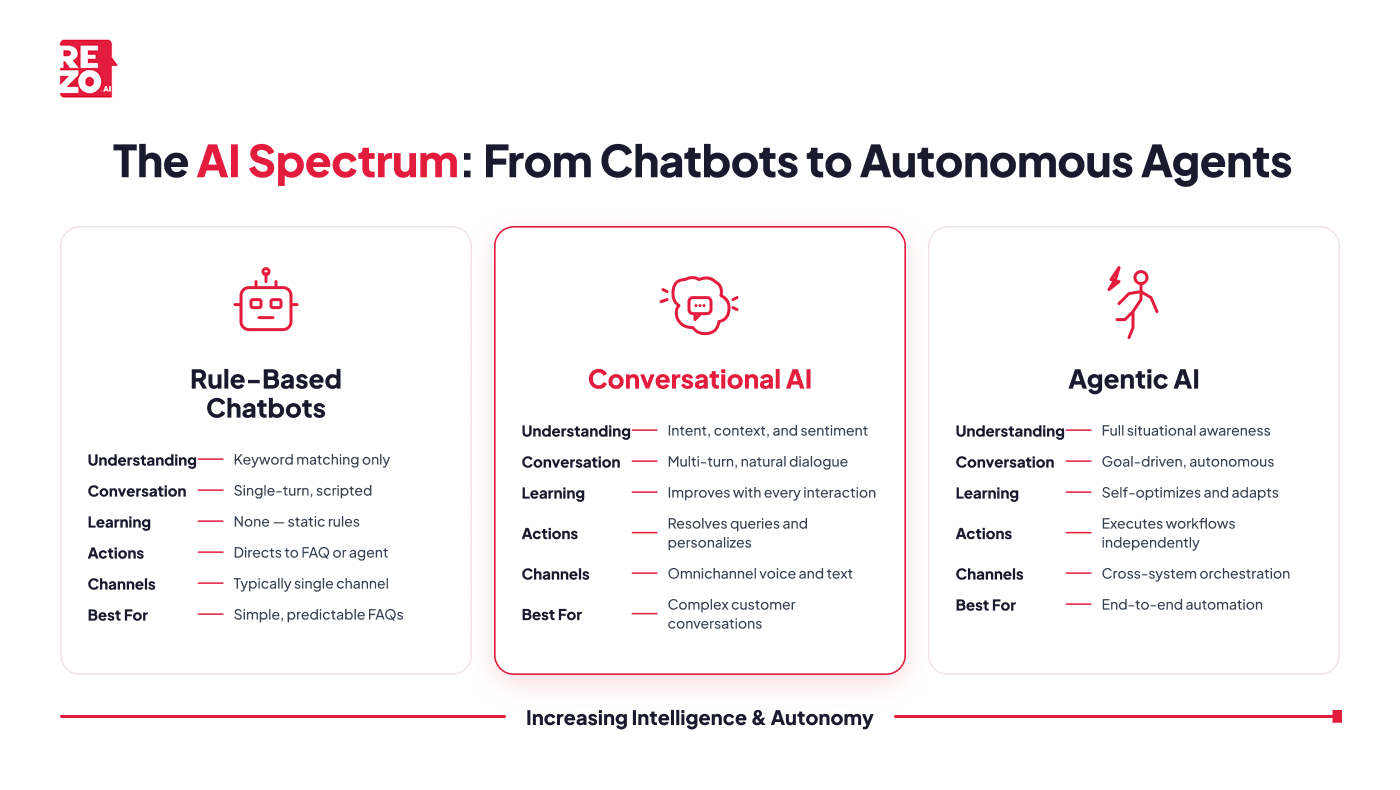
AI chatbots that rely on scripted decision trees work well for simple, predictable queries ("What are your store hours?") but break down the moment a customer goes off-script. They match keywords, not user intent. Ai powered chatbots represent an improvement, but they still lack the deep learning capabilities of true conversational AI models.
Conversational AI understands context, grasps intent, handles ambiguity, and maintains coherent multi-turn conversations. When a customer says, "Actually, I changed my mind about the blue one," conversational AI knows what "the blue one" refers to from earlier in the conversation drawing on past interactions to maintain conversational flow. A traditional chatbot does not have this natural language understanding capability.
Generative AI is a related but distinct technology. It creates new content, whether text, images, or code. Combining conversational AI and generative AI is increasingly common, with conversational AI platforms leveraging new generative ai capabilities to produce more natural and contextually rich responses. These generative ai capabilities allow conversational AI systems to go beyond scripted answers and generate truly relevant responses tailored to each user's context.
Agentic AI represents the next evolution. Conversational AI agents powered by agentic systems do not just converse; they autonomously take actions. They can schedule appointments, process refunds, escalate cases, and execute multi-step workflows without human intervention. According to MarketsandMarkets, the generative AI agents segment is growing at 25.5% CAGR, making it the fastest-growing category. Virtual agents powered by this conversational AI and generative AI combination can handle end-to-end workflows independently. Learn more about how agentic AI voice agents are transforming customer engagement.
Think of it as a spectrum: rule-based chatbots > conversational AI > agentic AI. Each step represents a leap in understanding, autonomy, and business value. What makes conversational AI the critical middle layer is its natural language processing foundation combined with deep learning that enables it to understand human language at scale.
How Do You Get Started with Conversational AI?
Implementing conversational AI in your enterprise does not require overhauling everything on day one. The most successful deployments follow an iterative, focused approach. Here is a practical roadmap for getting started.
Step 1: Identify high-volume, repetitive interaction types. Look at your contact center data and pinpoint the complex queries that consume the most agent time while following predictable patterns. Password resets, order status inquiries, appointment booking, and balance checks are common starting points. These are the interactions where conversational AI technology delivers immediate, measurable impact. Voice assistants and speech recognition-powered tools can handle many of these through automatic speech recognition alone.
Step 2: Audit your data readiness. This is where many enterprises stall. Accenture reports that 75% of executives cite good quality data as the most valuable ingredient for artificial intelligence success. Before selecting a conversational AI platform, assess whether your interaction data is clean, structured, and accessible. Your historical customer conversations the user input, dialogue patterns, and human input your teams have processed are the fuel that trains conversational AI models to understand your specific business context.
Step 3: Start with a focused pilot. Choose one channel (voice or chat) and one use case. Run a controlled pilot, measure outcomes against clear KPIs (resolution rate, handle time, customer satisfaction), and use the results to build organizational buy-in. Speech recognition accuracy and conversational flow quality are critical metrics to track during this phase.
Step 4: Plan for human-AI handoff. No conversational AI system should operate without a clear escalation path for complex queries that require human judgment. Design seamless handoff protocols so customers never feel stuck in an automated loop. The best conversational AI systems transfer full context including user input history and sentiment so the customer never has to repeat themselves. This ensures complex interactions are resolved with both speed and empathy.
Step 5: Build responsible AI governance early. According to PwC, nearly 50% of C-suite leaders struggle to turn responsible AI principles into operational processes. Establish data privacy safeguards, bias monitoring, and transparency guidelines before scaling, not after.
The readiness gap is real but solvable. Accenture finds that only 31% of companies have made significant AI investments despite 97% believing in its transformative potential. The enterprises that close this gap first will build a compounding advantage as their conversational AI systems learn and improve with every interaction.

What is the Future of Conversational AI?
The conversational AI landscape is shifting from reactive to proactive. The next generation of conversational AI systems will not just respond to customer queries; they will anticipate needs before customers even reach out. Imagine your conversational AI detecting a pattern of failed login attempts and proactively reaching out to the customer with a secure identity verification flow, resolving the issue before frustration sets in.
Multimodal interactions are accelerating this shift. Voice, text, video, and visual AI are converging into unified customer experience platforms where customers move seamlessly between channels without losing context. Deeper personalization, powered by real-time data, machine learning, and natural language understanding, will make every interaction feel tailored rather than templated. Advances in speech recognition and user input processing will enable conversational AI tools to handle human speech across languages and dialects with near-perfect accuracy.
But the most significant shift is the deepening partnership between humans and artificial intelligence. The future of customer experience will not be defined by how much you automate. It will be defined by how intelligently you blend AI efficiency with human empathy. Enterprises that invest in this balance now will find their conversational AI solutions growing smarter with every conversation, building an experience moat that competitors cannot easily replicate.
Remember the customer with the unauthorized charge at 11:47 PM? In the near future, conversational AI will have already detected the anomaly, reached out proactively, and resolved the issue before that customer even noticed. That is the trajectory, and the enterprises moving now are the ones shaping it.
If you are evaluating how conversational AI can transform customer experience in your industry, Rezo AI is helping enterprises across BFSI, healthcare, e-commerce, and telecom build intelligent, agentic CX platforms that scale. The right time to start was yesterday. The next best time is now.
Frequently Asked Questions
How is conversational AI different from a regular chatbot?
Traditional chatbots follow scripted decision trees and match keywords. Conversational AI understands intent, reads context, handles ambiguity, and maintains coherent multi-turn conversations. It learns and improves over time through machine learning, delivering more natural and accurate responses with every interaction. This ability to respond to human language contextually and enhance user engagement is what separates modern conversational AI from legacy ai powered chatbots.
Will conversational AI replace human agents?
No. Conversational AI handles high-volume, repetitive tasks so human agents can focus on complex and emotionally sensitive interactions. The most successful enterprises use a hybrid model where AI manages routine queries and humans handle cases requiring judgment, empathy, and creative problem-solving. Rather than replacing people, conversational AI solutions augment human capabilities, handling user queries, delivering personalized interactions, and answer questions at scale while your team tackles the work that demands genuine human input and emotional intelligence.
Frequently Asked Questions (FAQs)


Take the leap towards innovation with Rezo.ai
Get started now