What is Voice of Customer and How it Drives your ROI?

What is Voice of Customer and How it Drives your ROI?


Your customers are talking. The question is: are you really listening?
Every day, thousands of customer interactions happen across your contact center, social channels, and support systems. Customers share what frustrates them, what delights them, and what would make them stay or leave. Yet most businesses capture only a fraction of these signals. Voice of the customer analysis changes that by turning scattered customer feedback into strategic intelligence that addresses real customer needs.
Why Most Businesses Miss 96% of Customer Feedback?
Here is a reality check: research shows that most businesses capture only about 4% of their customer feedback. The remaining 96% sits in unanalyzed call recordings, overlooked chat transcripts, and ignored social mentions. This gap represents missed opportunities to understand customer pain points and improve customer satisfaction.
Traditional customer surveys have been the go-to method for gathering customer feedback. But surveys only capture what you think to ask, from customers who bother to respond. Meanwhile, the richest insights often live in unstructured conversations where customers speak freely without prompts.
According to Gartner, 60% of organizations with voice of the customer programs are now supplementing surveys by analyzing voice and text interactions. This shift signals a fundamental change in how enterprises listen to their customers and collect customer feedback through multiple channels.
The cost of missing these signals is real. When you cannot hear early warning signs of frustration and customer pain points, existing customers leave without giving you a chance to fix the problem.
What is Voice of Customer Analysis?
Voice of the customer analysis is the systematic process of capturing, analyzing, and acting on customer feedback to understand customer needs, customer preferences, and experiences. It goes beyond simple data collection. VoC programs transform raw customer input into actionable insights that drive business decisions and continuous improvement.
Think of it as the difference between hearing and truly listening. Customer feedback tells you what someone said. Voice of the customer analysis tells you what it means and what you should do about it to improve customer satisfaction.
Modern VoC programs pull valuable insights from multiple sources through comprehensive feedback collection:
- Direct feedback: Customer surveys, customer interviews, focus groups
- Indirect feedback: Social media, online reviews, customer support interactions, customer service interactions
- Inferred feedback: Customer behavior data, purchase patterns, website analytics
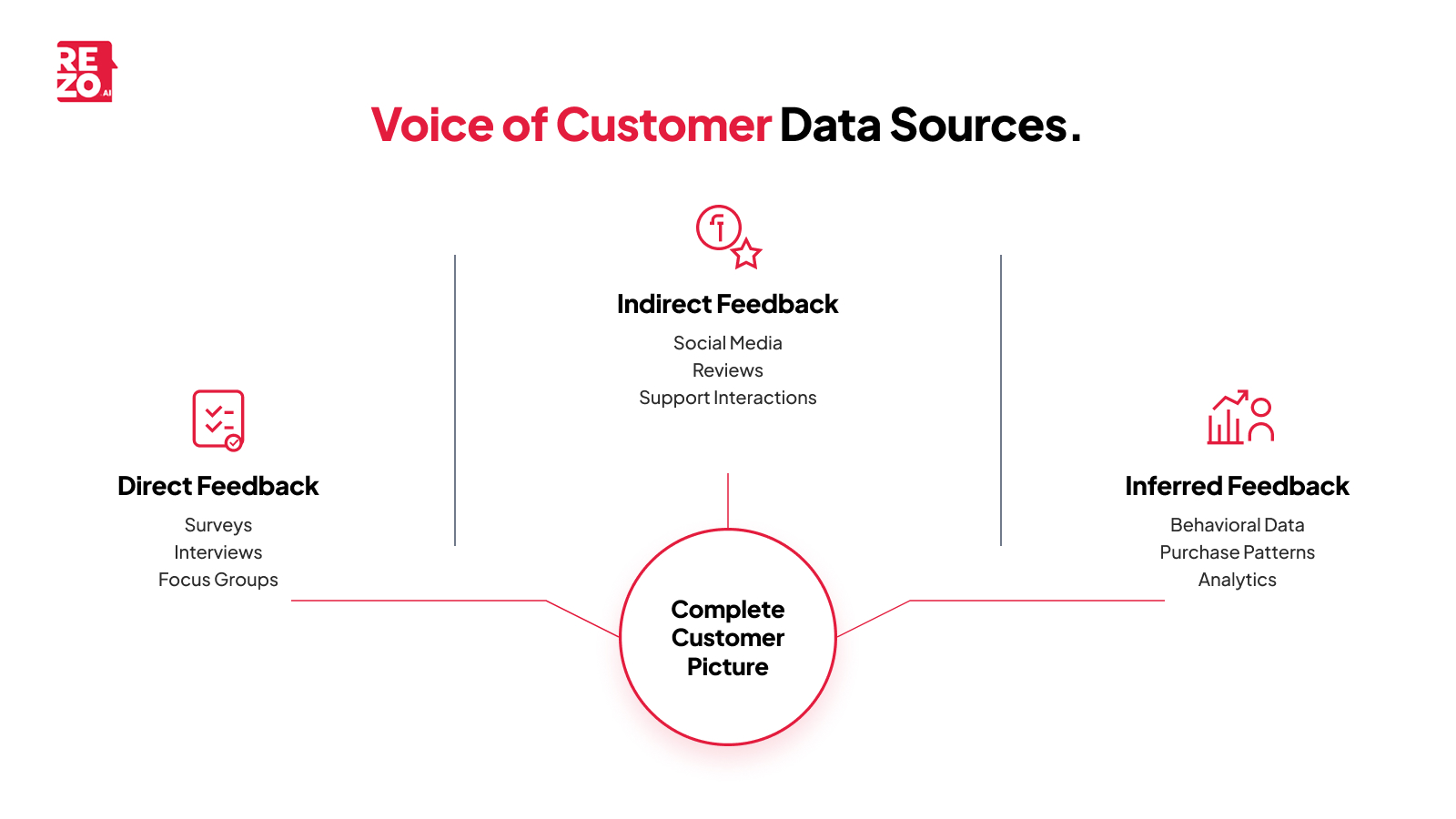
The goal is to create a complete picture of the customer experience by connecting signals across every customer touchpoint in the customer journey. This comprehensive approach to VoC data collection helps identify patterns in customer sentiment and customer preferences.
Why Voice of Customer Analysis Matters for Your Business
The numbers tell a compelling story. Deloitte research shows that companies with a customer-centric culture are 60% more profitable than those that are not.
Voice of the customer analysis is not just about measuring customer satisfaction. It is about identifying opportunities to improve products, streamline processes, and build customer relationships that last. Organizations that gather customer feedback systematically gain a deeper understanding of customer needs and can deliver exceptional customer experience.
The Real Cost of Ignoring Customer Voices
When customer signals go unheard, the consequences compound. Forrester research shows that companies focusing on customer feedback experience a 25% reduction in churn. Flip that around, and ignoring VoC feedback means accepting preventable customer loss and declining customer loyalty.
Consider this: in contact centers, over 90% of banking customer service interactions happen over voice. In a five-minute call, more than 2,000 words are exchanged. Yet managers typically listen to only 2% of recorded calls. The remaining 98% contains VoC insights that could prevent churn, improve products, and identify process failures. This feedback data represents untapped potential for customer success.
How Does Voice of Customer Analysis Work?
Effective voice of the customer analysis combines multiple techniques to extract meaning from customer feedback data. Here is how successful voice of the customer programs work.
Sentiment Analysis
Sentiment analysis uses natural language processing (NLP) to understand the emotional content of customer feedback. It classifies statements as positive, negative, or neutral and detects emotional intensity to gauge customer sentiment accurately.
This matters because what customers say often differs from how they feel. A customer might say "fine" while their tone and word choice reveal frustration. Today, 62% of new VoC tools feature real-time sentiment analysis powered by machine learning, allowing customer success teams to identify customer pain points as they happen.
Thematic Analysis
Thematic analysis categorizes VoC feedback into topics and patterns. AI tools automatically tag conversations by subject matter, making it easier to spot recurring issues and customer complaints across multiple channels.
Instead of manually reviewing thousands of customer interactions, thematic analysis surfaces what customers talk about most. You might discover that "billing confusion" appears in 40% of negative interactions, or that "delivery timing" drives most customer complaints in a specific region. This helps identify trends and prioritize customer pain points.
Predictive Analytics
Predictive analytics takes voice of the customer programs to the next level by forecasting customer behavior. Statistical models and machine learning analyze historical and current VoC data to predict which customers are at risk of churning, what products they might need, and when they are likely to reach out.
Gartner reports that companies with VoC programs spend 25% less on customer retention than those without. Predictive capabilities make that possible by enabling proactive engagement before problems escalate, helping retain customers and increase customer satisfaction.

How to Implement Voice of Customer Analysis
Building an effective voice of the customer program requires a structured approach. Here is a framework that works for enterprises handling high volumes of customer interactions.
Define Your Goals and Success Metrics
Start by identifying what you want to learn from your voice of the customer program. Are you trying to reduce churn? Improve product features? Streamline support processes? Your goals determine what customer data you collect and how you analyze it.
Set measurable key performance indicators tied to business outcomes. Common metrics include Net Promoter Score (NPS), customer satisfaction score (CSAT), customer effort score (CES), and customer retention rate. But do not stop at survey scores. Measure the impact of actions you take based on VoC insights to demonstrate real customer success.
Map Customer Touchpoints and Data Sources
Document every channel where customer interactions occur. This includes voice calls, chat, email, social media, online reviews, customer surveys, focus groups, and customer interviews.
For each customer touchpoint, identify:
- What customer feedback exists there
- How feedback collection currently happens (if at all)
- What systems store that customer data
- Who owns that channel
Most enterprises discover VoC feedback trapped in silos. Sales has one view, support has another, and marketing sees something different. Mapping customer touchpoints reveals these gaps in your voice of the customer program.
Centralize and Analyze Your Data
Consolidate customer feedback into a unified platform for comprehensive data collection. This might be a dedicated voice of the customer solution, a CRM with analytics capabilities, or a customer experience management platform.
Once centralized, apply consistent tagging and categorization to your VoC data. Use AI to automate analysis at scale. Group feedback data by topic, customer sentiment, customer segment, and journey stage.
Look for patterns in your customer feedback data:
- What themes appear most frequently?
- How does customer sentiment vary by channel or customer segment?
- What customer pain points correlate with churn or escalations?
- What customer needs remain unaddressed?
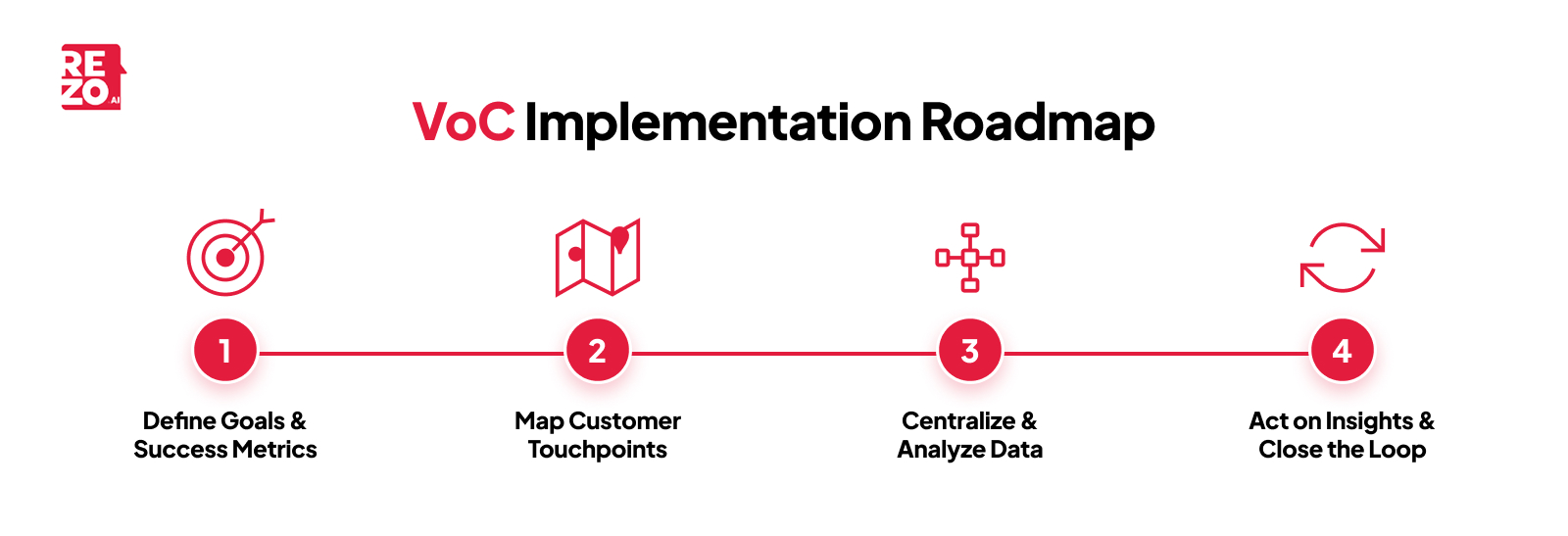
Act on Insights and Close the Loop
Analysis without action wastes effort. Create processes to route VoC insights to teams who can act on them. Product feedback goes to R&D. Service issues go to operations. Marketing insights inform campaigns that address customer preferences.
Prioritize based on impact on customer experience. Not every piece of qualitative feedback requires immediate action. Focus on issues affecting the most existing customers or causing the most damage to customer satisfaction.
Then close the feedback loop. Let customers know their customer feedback led to change. This builds trust, improves customer loyalty, and encourages continued engagement. Research shows that 30% reduction in customer attrition is achievable by proactively addressing frustration signals and customer concerns.
What Makes AI-Powered VoC Different?
Traditional voice of the customer programs relied heavily on customer surveys and manual analysis. You asked specific questions through feedback requests and hoped customers responded. Analysis meant reading through qualitative customer feedback or watching dashboards update quarterly.
AI-powered voice of the customer programs change the game in three fundamental ways.
Scale: Instead of analyzing 2% of customer interactions, AI processes 100%. Every call, chat, and email becomes a data point for your customer program. Nothing slips through the cracks. Speech analytics solutions now make it possible to analyze every conversation automatically and gather feedback comprehensively.
Speed: Real-time analysis means VoC insights emerge while conversations happen. If customer sentiment drops during a call, customer success managers can intervene. If a product issue spikes, teams know immediately. Contact center analytics deliver this real-time customer feedback visibility to improve customer satisfaction quickly.
Depth: AI detects patterns humans miss. It identifies subtle correlations between word choices and business outcomes, surfaces emerging themes before they become crises, and predicts customer behavior based on signals invisible to manual review. This qualitative insights capability helps translate customer feedback into a deeper understanding of customer needs.
The shift is significant. Gartner predicts that 60% of organizations will move beyond customer surveys to analyze voice and text interactions through advanced VoC programs. Those who make this shift gain a competitive advantage in understanding and serving customers.
The Business Impact of Successful Voice of Customer Programs
Organizations that invest in robust voice of the customer programs see measurable returns across multiple dimensions:
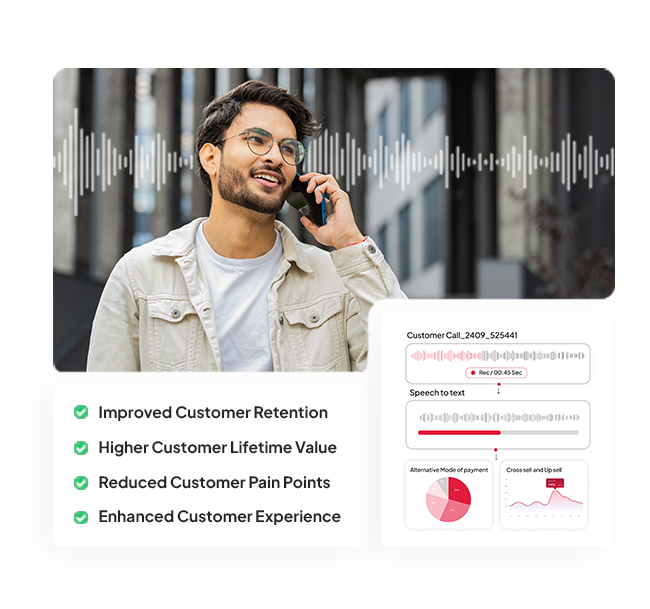
- Improved Customer Retention: VoC programs help identify at-risk customers before they leave, enabling proactive outreach to address customer concerns and retain customers.
- Higher Customer Lifetime Value: Understanding customer needs and customer preferences allows for better cross-selling and upselling, increasing customer lifetime value over time.
- Reduced Customer Pain Points: Systematic feedback collection reveals friction in the customer journey, enabling continuous improvement that benefits all existing customers.
- Enhanced Customer Experience: Acting on VoC feedback creates a customer-centric culture where customer expectations are consistently met, driving customer loyalty and customer success.
- Increased Customer Satisfaction: When organizations improve customer satisfaction through VoC insights, satisfied customers become advocates who refer new business.
Getting Started with Voice of Customer Analysis
You do not need to overhaul everything at once. Start with your highest-volume customer interaction channel. For many enterprises, that means voice calls in the contact center where customer service interactions happen daily.
Focus on quick wins. Identify one or two critical questions you need answered about customer needs and build your initial analysis around those. Demonstrate valuable feedback collection before expanding scope.
Build cross-functional support for your voice of the customer program. VoC programs work best when valuable insights flow across departments. Get buy-in from operations, product, marketing, and executive leadership early.
Finally, iterate. Voice of the customer analysis is not a one-time project. Customer expectations evolve, and your customer program should evolve with them through continuous improvement and ongoing feedback collection.
The enterprises that thrive are those that hear their customers clearly and act on what they learn. Voice of the customer analysis gives you the tools to do both turning customer feedback into actionable insights that drive customer success and deliver measurable business outcomes.
Frequently Asked Questions
What is the difference between voice of customer and customer feedback?
Customer feedback refers to any comment or input from customers. Voice of the customer analysis goes deeper by systematically collecting feedback, categorizing, and analyzing that VoC data to uncover patterns, predict customer behavior, and drive strategic decisions across your organization. VoC programs transform raw feedback data into actionable insights.
How often should you conduct voice of customer analysis?
Voice of the customer analysis should be continuous rather than periodic. Modern AI-powered VoC programs enable real-time analysis of every customer interaction. At minimum, review aggregated VoC insights weekly and conduct deeper strategic analysis monthly or quarterly to identify trends and address customer pain points proactively.
What are the key benefits of VoC programs?
Successful voice of the customer programs deliver multiple benefits: they improve customer satisfaction, increase customer loyalty, reduce customer pain points, enhance customer experience, provide valuable insights into customer needs, enable customer success teams to be proactive, and create a customer-centric culture that drives business outcomes.
Frequently Asked Questions (FAQs)


Take the leap towards innovation with Rezo.ai
Get started now

.jpg)