.jpg)
7 Strategies to Improve First Call Resolution (FCR)

7 Strategies to Improve First Call Resolution (FCR)
%20Blog.jpg)


When a customer has to call back about the same issue, everyone loses. The customer gets frustrated. Your support team wastes time revisiting problems instead of solving new ones. And your call center's operating costs climb with every repeat interaction.
The good news is that first call resolution is one of the most improvable metrics in your contact center. This guide breaks down exactly how to improve your first call resolution rate with strategies that work in the real world.
Why First Call Resolution Matters More Than Any Other Metric?
First call resolution (FCR) measures the percentage of customer issues resolved on the first contact without requiring a callback, transfer, or follow-up. It sounds straightforward, but its impact on your business is anything but simple.
Research from SQM Group reveals a powerful correlation: for every 1% improvement in FCR, customer satisfaction increases by 1%, operating costs decrease by 1%, and Net Promoter Score rises by 1.4 points. That same 1% improvement translates to approximately $286,000 in annual savings for a typical midsize call center.
The flip side is equally telling. Customer satisfaction drops an average of 15% with each call back required. Research says only 37% of consumers remain loyal to a brand after a high-effort resolution experience, compared to 61% when resolution is quick and easy. Poor customer service drives churn faster than almost any other factor.
When you improve first call resolution, you create a ripple effect across your entire operation: a better customer experience, lower costs, and more engaged agents. High first call resolution is ultimately a reflection of your company's ability to serve customers well on every interaction.
What Does a Good First Call Resolution Rate Look Like?
Before you can improve FCR, you need to know where you stand. The industry average first call resolution rate hovers around 70%, meaning nearly one in three customers has to reach out again about the same problem.
A good FCR rate falls between 70% and 79%. World-class performance is 80% or higher, but only about 5% of contact centers achieve that standard. The average call center still has significant room to grow.
FCR performance also varies significantly by industry. Retail leads at 78%, followed by insurance at 76%. Financial services and energy companies average around 71%, while tech support trails at 65% due to the inherent complexity of technical issues.
Call types matter too. General inquiries resolve at 74% on first contact, while claims drop to just 59%. Understanding these benchmarks helps you set realistic first call resolution goals for your specific context and call center environment.
How to Measure First Call Resolution the Right Way?
You cannot improve what you do not measure accurately. Measuring first call resolution starts with the basic FCR formula:
But how you measure matters as much as what you measure. There are two approaches.
External measurement uses a post-call survey method to ask customers directly whether their issue was resolved. This approach lets the customer decide, which is what ultimately counts. It is considered the most accurate way of tracking FCR and reflects the real customer experience.
Internal FCR measurement uses CRM data or call tracking to monitor whether customers call back within a set window, typically 1 to 30 days. While easier to implement, internal methods tend to inflate the FCR rate by 10-20% compared to external surveys.
The difference is significant. If your internal metrics show an 80% resolution rate but customers would rate it at 65%, you are optimizing for the wrong number. Use external measurement as your primary benchmark and internal tracking for operational visibility. Both methods are key performance indicators, but customer-validated data should always take priority
What Causes First Call Resolution to Drop?
Before jumping into solutions, diagnose what is actually driving repeat calls in your call center. The usual culprits include:
Information silos: Agents cannot see the customer's history, previous interactions, or account details, forcing customers to repeat themselves and extending resolution time. These gaps in the customer journey create unnecessary friction.
Knowledge gaps: Support agents lack the product knowledge or troubleshooting skills to resolve customer problems without escalation or callbacks.
Policy barriers: Rigid approval hierarchies prevent call center agents from handling standard issues like refunds, credits, or exceptions without manager involvement.
Routing failures: Phone calls land with agents who lack the expertise to help, resulting in transfers to the wrong department that frustrate customers and drag down the first call resolution rate.
Broken processes: Backend issues like fulfillment errors, billing glitches, or system limitations create problems that frontline center agents simply cannot fix on the initial call.
Unclear ownership: When no one takes accountability for seeing an issue through to contact resolution, customers fall through the cracks and are forced to follow up repeatedly.
Identifying your specific barriers is the essential first step toward improving FCR performance.
How to Improve First Call Resolution: 7 Strategies That Work
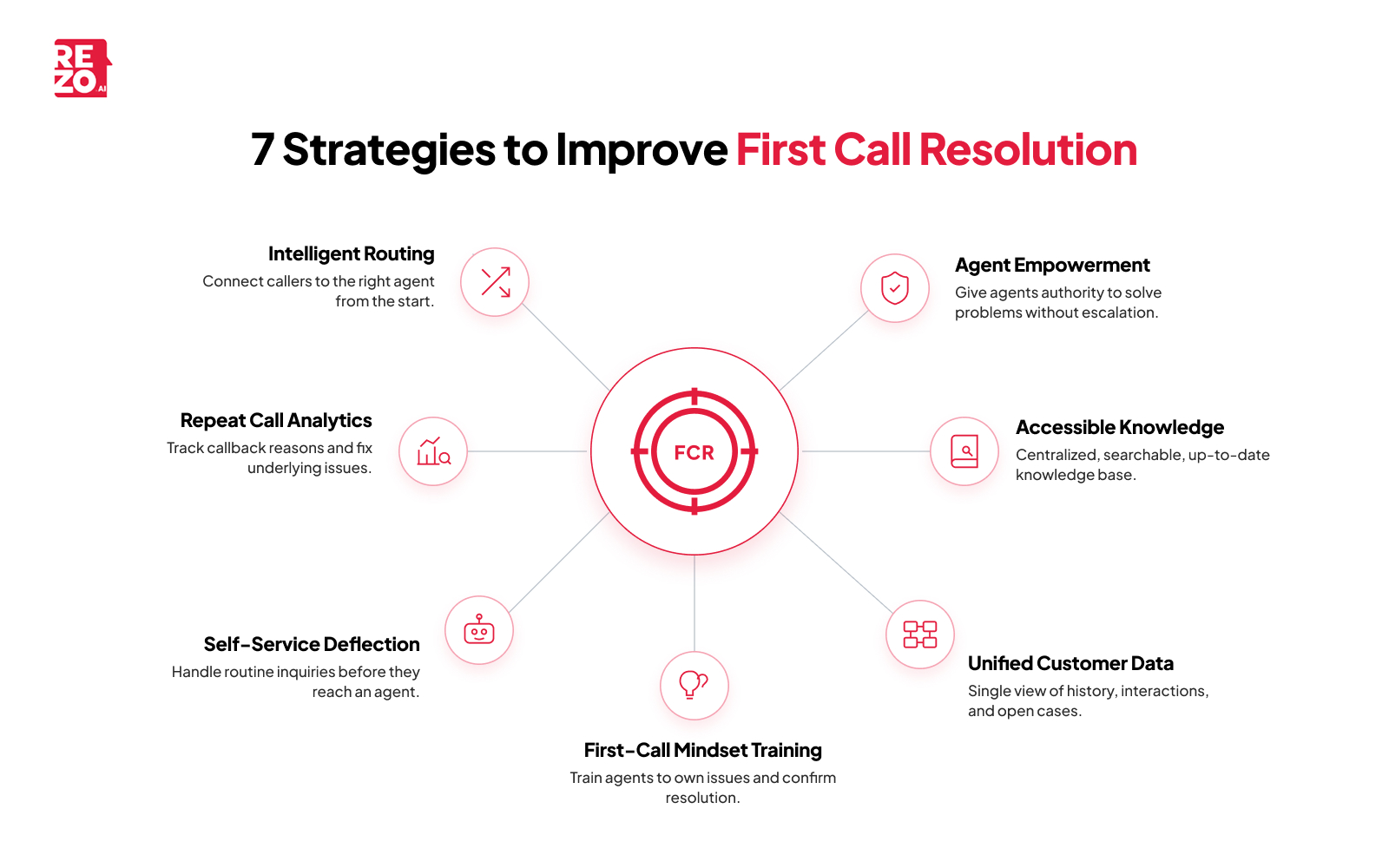
Here are seven strategies that consistently move the needle on first call resolution. Each one targets a different root cause, so the best results come from combining several approaches.
1. Route Calls to the Right Agent from the Start
The fastest path to better first call resolution often begins before the agent picks up the phone. Intelligent call routing analyzes customer data, issue type, and agent expertise to connect callers with the right person immediately.
Modern routing goes beyond basic interactive voice response menus. AI-powered systems consider customer history, predicted issue complexity, language preferences, and even sentiment to make real-time routing decisions. When customers reach the right agent the first time, transfers drop and contact resolution rates climb. Every call that reaches the correct person on the first attempt is one step closer to a resolved interaction.
2. Give Agents the Authority to Solve Problems
Agents who feel empowered to make decisions resolve more calls on the first attempt. Rigid approval workflows and excessive escalation requirements slow everything down and hurt your FCR rate.
Give your customer service team the authority to handle standard issues: process reasonable refunds, make service exceptions, and commit to solutions without waiting for manager sign-off. Define clear boundaries, then trust your support team to operate within them.
When agents resort to "powerless-to-help" language like "there is nothing I can do," customers almost always call back seeking someone who can help. A second call means a failed first call resolution, higher costs, and lower customer satisfaction. Train agents to focus on what they can do rather than what they cannot.
3. Make Knowledge Instantly Accessible
Support agents need fast access to accurate information. A centralized knowledge base with FAQs, troubleshooting guides, scripts, and policy documentation gives them the tools to handle customer interactions without guesswork.
Keep the knowledge base searchable, organized, and current. Outdated information creates more problems than it solves. Establish ownership for regular updates and make it easy for customer service team members to flag content that needs revision. When agents can quickly find the right answer, first call resolution improves naturally.
4. Unify Customer Data Across Systems
Nothing kills first call resolution faster than asking customers to repeat information they have already shared. When agents have complete visibility into the customer journey, including previous interactions, purchases, and open cases, they can skip the repetitive questions and jump straight to resolution.
Integrate your contact center software with your customer relationship management platform, billing systems, and other relevant data sources. The goal is a single, unified view of each customer that loads automatically when the call connects. This unified view is what allows your call center to resolve issues efficiently across all communication channels.
5. Train for First-Call Mindset
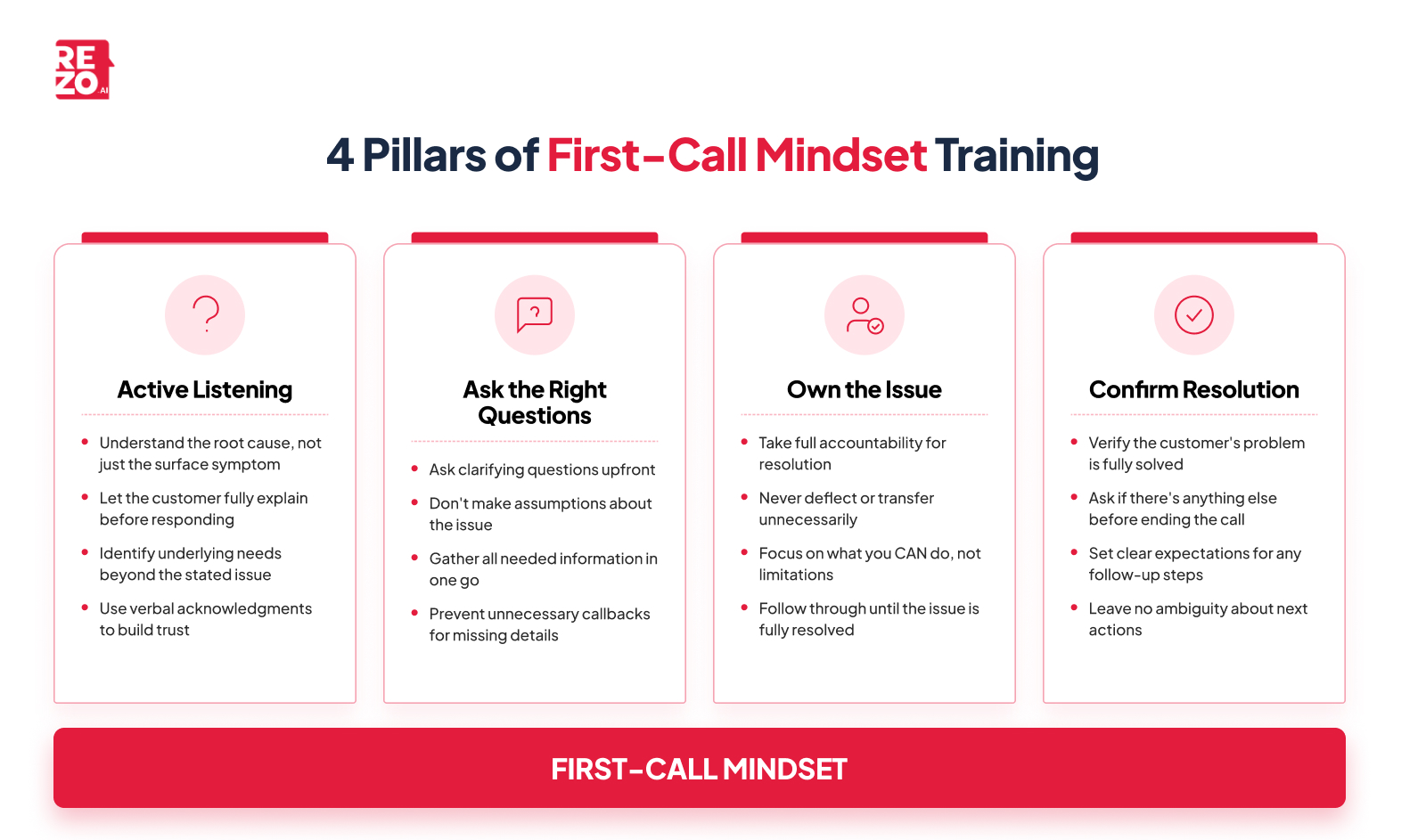
Training should instill a first-call mindset, not just product knowledge. This means teaching agents to:
- Listen actively to understand the root cause, not just the surface symptom
- Ask clarifying questions upfront rather than making assumptions
- Take ownership of the issue rather than deflecting or transferring
- Confirm resolution before ending the call, so customers resolve their concern completely
Role-play exercises using real scenarios help agents practice resolving customer interactions in one attempt. Make first call resolution metrics a visible part of performance conversations so your customer service team understands their importance. When agents internalize a first-call mindset, satisfied customers become the norm rather than the exception.
6. Deflect Simple Issues to Self-Service
Effective self-service options handle routine inquiries before they ever reach an agent, freeing your support department to focus on complex issues that genuinely require human expertise.
IVR systems, chatbots, a well-designed customer service portal, and online FAQs can resolve password resets, balance inquiries, order status checks, and similar straightforward requests. When self-service cannot resolve an issue, ensure smooth handoffs to live agents with full context intact so the customer does not have to start over. This protects your first call resolution rate by giving agents more time for the cases that truly need them.
7. Track Repeat Call Reasons and Fix Them
Use analytics to understand why customers call back. Track repeat call reasons, identify patterns, and address the underlying issues. Reducing repeat requests is one of the fastest ways to improve your first call resolution rate.
If 20% of follow-up calls relate to billing confusion, the fix may be clearer invoices rather than better agent training. If customer contacts spike because promised callbacks never happened, the issue is process adherence, not agent skill. Customer feedback from post-call surveys can also highlight problem areas that internal data misses.
Conversation analytics can surface these patterns across 100% of customer interactions, revealing insights that manual QA sampling would miss. Tracking FCR alongside repeat call data gives you the complete picture.
How AI Is Changing the Game for First Call Resolution?
Artificial intelligence is transforming how call centers approach FCR. Here is what leading organizations are doing to improve first call resolution across their operations.
- Real-time agent assist: AI-powered tools listen to phone calls in real time and surface relevant knowledge, suggest responses, and prompt next steps. This reduces agent search time and improves answer accuracy. Research shows that AI-powered agent assist improves first call resolution accuracy by up to 25%, helping resolve customer problems on the spot.
- Intelligent routing: AI goes beyond skill-based routing to consider customer intent, predicted issue complexity, and agent performance patterns. The result is better matches between customers and agents from the start, which directly lifts first call resolution and reduces the need for transfers.
- Conversation analytics: Instead of sampling a small percentage of calls for QA, conversation intelligence analyzes every interaction. It identifies repeat call patterns, detects sentiment shifts, and flags the issues that cause callbacks. These insights are essential contact center metrics for any organization serious about resolving customer interactions on the first attempt.
- After-call automation: AI automatically summarizes calls, capturing key details that save agents 30 to 60 seconds of after-call work per interaction. That saved time lets agents focus more attention on the next caller, contributing to higher customer satisfaction and better FCR performance.
Companies using these AI capabilities report significant improvements in their first call resolution rate and reductions in average handle time of 60% or more. The call center industry is rapidly adopting these tools as standard practice.
How to Improve First Call Resolution? Roadmap
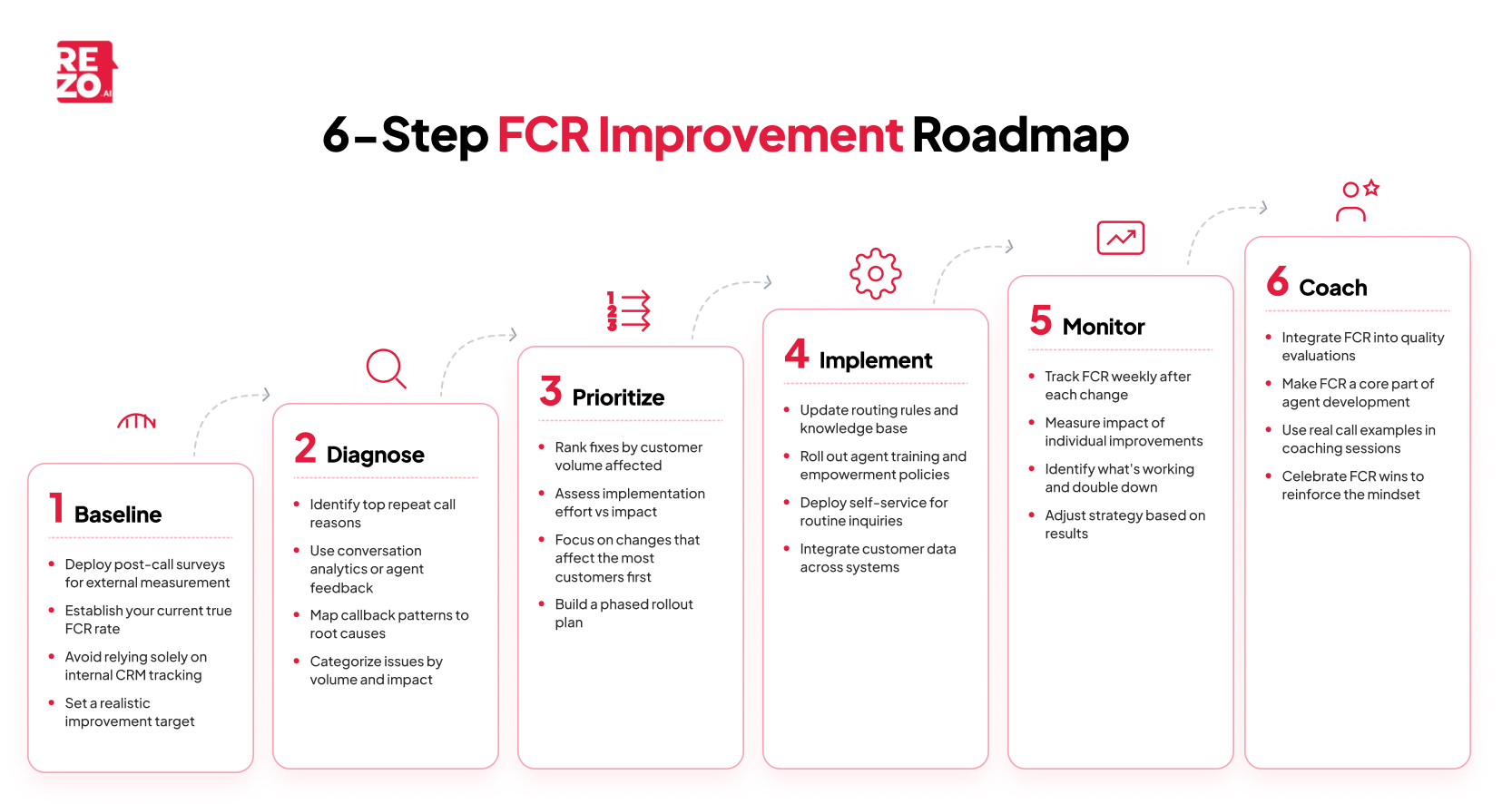
Improving first call resolution requires a structured approach. Here is a six-step framework to guide your efforts and drive business growth.
Step 1: Baseline your current FCR rate with external measurement. Post-call surveys give you the most accurate starting point and reflect the true customer experience.
Step 2: Identify your top repeat call reasons through conversation analytics or agent feedback. Find out exactly why customers are calling back along the entire customer journey.
Step 3: Prioritize fixes by volume and impact. Focus on changes that will affect the most customer contacts first.
Step 4: Implement changes in phases. Whether routing rules, knowledge base updates, or agent training, roll out improvements systematically. Each phase should have clear first call resolution goals.
Step 5: Monitor your resolution rate weekly and track the impact of each change. Learn what works and double down. Share FCR performance data with your support team so everyone stays aligned.
Step 6: Integrate first call resolution into quality coaching. Make it part of how you evaluate and develop agents, not just a number on a dashboard. When FCR is woven into daily operations, improvements sustain themselves and drive higher customer satisfaction over time.
Start Moving the Needle on FCR
First call resolution is not a vanity metric. It directly affects customer satisfaction, operating costs, agent morale, and customer retention. The strategies in this guide work because they address the real reasons customers have to call back: information gaps, policy barriers, routing failures, and broken processes.
Start with accurate measurement. Diagnose root causes before implementing fixes. Then systematically address them, beginning with the highest-impact opportunities. Customers tend to remember how easy or difficult it was to get help, and improving first call resolution ensures those memories are positive.
Every 1% improvement in FCR compounds into real results. Improve customer satisfaction, reduce costs, and build a contact center your customers actually want to interact with. The question is not whether to improve your first call resolution. It is how quickly you can get started.
Frequently Asked Questions
What is the difference between first call resolution and first contact resolution?
First call resolution (FCR) refers specifically to resolving issues during phone calls. First contact resolution is broader, measuring contact resolution rates across all channels including chat, email, social media, and voice. As contact centers have become omnichannel, the first contact resolution rate has become the more commonly used term since it captures the full range of ways customers reach out for help.
Research shows that for every 1% improvement in FCR, employee satisfaction increases by 1% to 5%. Agents who resolve issues on the first call experience less frustration from handling repeat complaints, leading to higher engagement and lower turnover rates. A strong first call resolution rate benefits your entire customer service team, not just your customers.
What is the average number of contacts needed to resolve a customer issue?
On average, it takes 1.5 contacts to resolve a customer inquiry. With the industry average first call resolution rate at 70%, approximately 30% of customers need to reach out at least twice before finding resolution. Reducing that number even slightly through better call center processes and empowered support agents can meaningfully improve customer satisfaction and lower operational costs.
Frequently Asked Questions (FAQs)


Take the leap towards innovation with Rezo.ai
Get started now