Managing 1,000+ Dealers? How Rezo AI Automates Support at Scale

Managing 1,000+ Dealers? How Rezo AI Automates Support at Scale
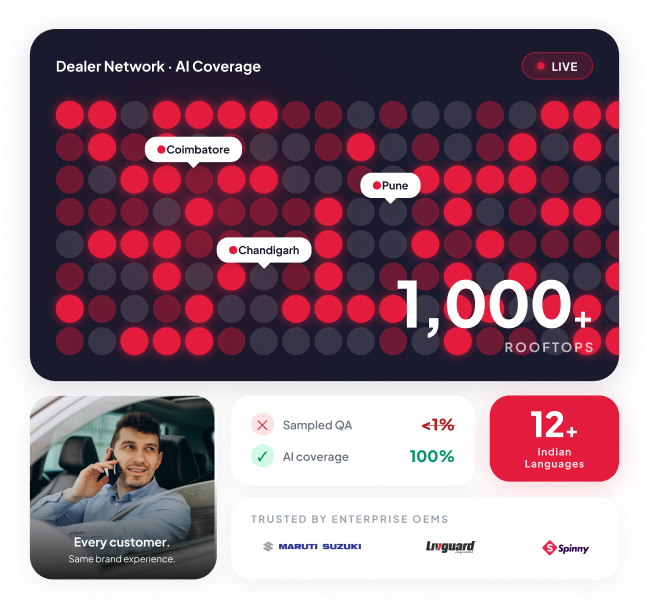


If you run customer experience for an automotive OEM, you already know the uncomfortable truth: your brand is not judged by your best dealer. It is judged by your worst one. When you are managing 1,000+ dealers across geographies, languages, and tenure, every missed call, mistranslated query, and inconsistent answer becomes a brand event and a quiet but compounding hit to customer satisfaction. This is the operating reality that most OEM CX leaders wake up to every Monday, and it is exactly the problem Rezo AI can help you solve. In this article, we look at why traditional dealer support breaks at scale, what an OEM-grade automation stack actually looks like, and how to roll one out across a thousand-dealer base in roughly 90 days. AI in manufacturing has spent a decade transforming the production line. For the manufacturing industry, what comes next looks very different artificial intelligence on the customer-facing side, and a way to turn network-wide consistency itself into a competitive advantage.
Why Dealer Networks Break When They Grow Past a Few Hundred Rooftops
A 200-dealer network can be policed with phone calls, regional managers, and quarterly audits. A 1,000-rooftop base cannot. The volume of customer interactions, the diversity of languages, and the inconsistency of frontline talent simply outrun any human-led oversight model. Trying to monitor dealer performance through sampled calls and after-the-fact reports leaves most of the actual conversations invisible. The result is what we call the "weakest rooftop" effect, where a customer's perception of your brand collapses to the experience offered by the dealer who picked up the phone today.
McKinsey's research on automotive customer experience makes this point plainly: customer data sits scattered across OEM CRM systems and dealer platforms, and "all OEMs will need to build a technology stack to capture and integrate customer data at every touchpoint" if they want to deliver consistent journeys. The challenge is not AI adoption at one dealer. It is consistency across the entire dealer base.
The symptoms are familiar: enquiry calls that never get returned, service bookings that drop into a regional language gap, complaints that escalate because nobody at HQ saw them in time, and CSI scores that jump 40 points between two rooftops in the same city. None of this is a dealer-quality problem in isolation. It is a network-design problem and one that AI in manufacturing has so far underinvested in, while the production line attracted most of the spend.
Also Read: AI In Manufacturing Industry
Why the Old Playbook Doesn't Scale
OEMs have not been idle. The old playbook is well-rehearsed: SOPs sent down from HQ, mystery shopper calls, quarterly audits, dealer scorecards built on a few sampled interactions. It is logical, but it does not scale.
Quarterly audits look at less than one percent of conversations. SOPs do not enforce themselves the moment an agent picks up a call. Mystery shoppers are slow, expensive, and reactive they tell you what went wrong six weeks after it happened, with no real time data to act on while the customer is still on the line. And in markets like India, where a single dealer footprint might span Hindi, Tamil, Bengali, Marathi, Kannada, and eight more languages, the linguistic coverage of a centralised QA team is inevitably patchy.
The honest summary is this: every layer of the existing playbook samples instead of covers. To run support consistently across 1,000+ rooftops, sampling has to give way to full coverage, and reactive review has to give way to real-time intervention.
What "Support at Scale" Actually Means for an OEM
Before we talk about how to automate, it is worth defining what "good" looks like. Support at scale, for an OEM running a large dealer network, comes down to three non-negotiables:
- Consistency. A customer in Coimbatore should hear the same brand-correct answer as a customer in Chandigarh, regardless of which rooftop picked up the call.
- Language coverage. Every customer should be served in the language they actually speak, not the language the dealer happens to speak.
- Closed-loop quality. Every interaction should be observable, scorable, and routable back to the right dealer manager for coaching or escalation.
These goals are channel-agnostic. The same standard has to hold whether the customer reaches out by voice, chat, WhatsApp, or email. Anything less is fragmentation in disguise and modern customer expectations, shaped by every other digital service the buyer uses, leave very little room for it.
How Agentic AI Changes the Operating Model?
Most of the AI in manufacturing conversation still centres on the factory floor predictive maintenance on production lines, machine learning and AI algorithms running quality control, smart factories squeezing more operational efficiency out of every shift. Those wins are real, and they are mostly internal. The story that has lagged is what AI in manufacturing looks like outside the plant: at the dealer, in the language the customer actually speaks, in the service bay where the brand promise either holds or breaks. That gap is where the manufacturing industry's next decade of customer-experience investment will land and where AI in manufacturing finally stops being only a factory-floor story.
Industry analysts agree that 2026 marks an inflection point for AI in automotive retail. The market trends are unambiguous: by this year, artificial intelligence has shifted from a forward-looking experiment to a baseline requirement for staying competitive in any large dealer footprint. As Deloitte notes in its work on post-sales customer experience, modern ai technologies now go well beyond automating routine inquiries. AI determines customer sentiment, coaches agents in real time, powers quality assurance across every interaction, and shoulders the routine decision making that used to need senior staff. The shift is not from "no AI" to "some AI." It is from standalone AI tools, plugged into individual dealers, to embedded agentic AI systems that run across the entire network.
Agentic AI is the technical name for software that handles autonomous decision making within defined guardrails. In a dealer-network context, it does not just answer FAQs. It triages an enquiry, books the service slot, dispatches roadside assistance, collects post-service feedback, and routes a compliance-flagged conversation to the regional manager handling routine tasks end-to-end with no human in the middle for the routine 80%.
For OEMs, the operating implication is significant. Instead of asking each dealer to install its own bot, its own QA tool, and its own analytics layer, the OEM deploys a single agentic fabric that sits above the dealer DMS and CRM stack. Brand-correct prompts, generative AI models tuned for Indian customer-dealer dialogue, machine learning escalation rules that adapt with each interaction, and central governance over network operations all live at the network level. Each dealer plugs in. Customers get a consistent experience. HQ gets a consolidated view.
Also Read: AI Voice Agents for OEMs: A Smarter CX Playbook
.jpg)
The Four Layers of a Network-Wide Support Stack
A practical, OEM-grade support stack has four layers. Each one solves a different part of the consistency problem, and together they cover the entire customer interaction lifecycle.
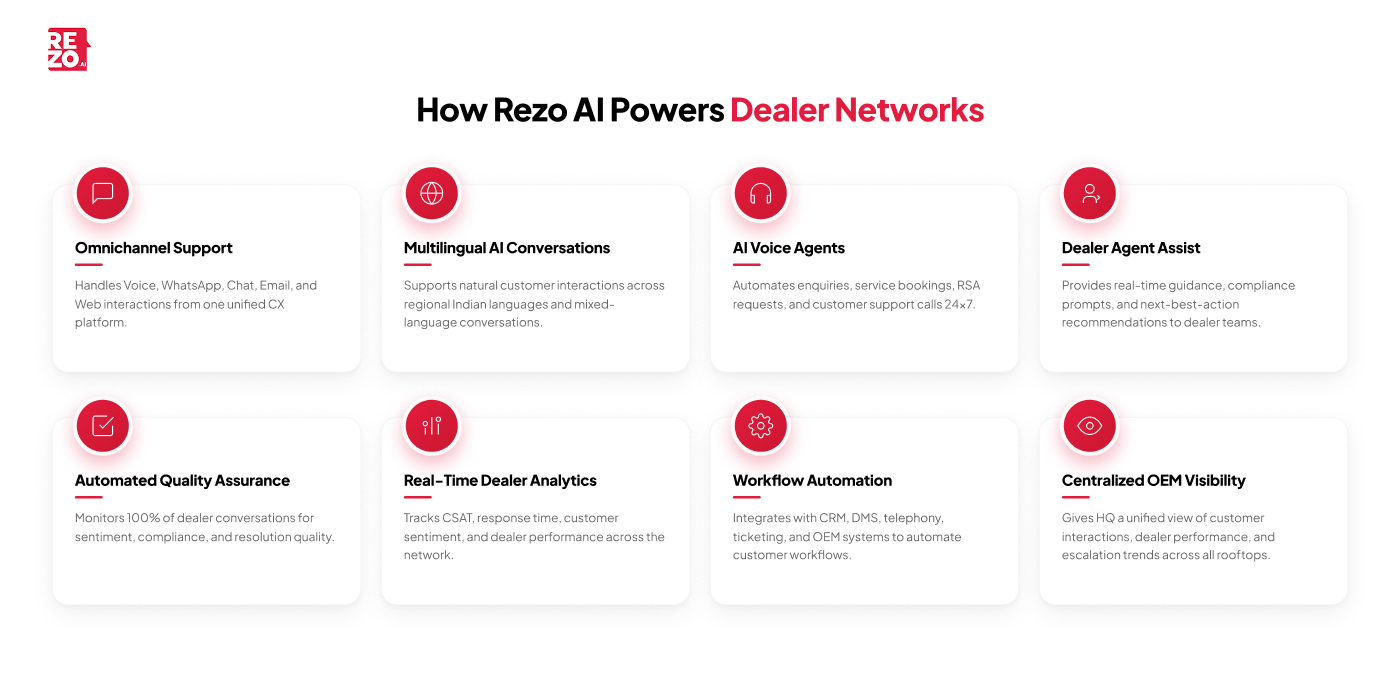
Layer 1: The front door — Voice and chat AI agents. This is where the customer first lands. AI agents handle inbound calls, WhatsApp messages, web chats, and email enquiries 24x7, in various Indian languages. Routine actions like service booking, document collection, status checks, and RSA requests get resolved end-to-end through AI driven automation, with no manual effort or manual intervention from dealer staff. Complex cases get handed to a live dealer agent with full context already populated.
Layer 2: Dealer agent assist. When a human agent at a dealer does pick up, they are not flying blind. The same AI system listens to the conversation, surfaces brand-approved talking points, flags compliance risks before they get said, and writes the call summary at the end; with machine learning continuously sharpening prompts as more dealer dialogues feed in. Among the key benefits: human error on script adherence drops sharply, and frontline staff churn becomes less painful because new joiners are productive faster with the AI handling the repetitive parts so the human can focus on the conversations that actually need judgement.
Layer 3: Quality control and analytics. Instead of sampling 1% of calls, the stack listens to 100%. AI powered systems run automated quality control on every interaction, scoring it for sentiment, intent, compliance, and resolution, and turning raw conversations into structured real time data the moment a call ends. Dealer-level scorecards roll up to regional and national dashboards. Predictive analytics and ongoing data analysis surface real time insights, support root cause analysis on emerging issues, and identify patterns long before they show up as operational risks or quarterly anomalies; a sudden drop in CSAT for a region, a recurring objection across the country, an emerging complaint trend. The result is data driven decisions at HQ instead of gut-feel reactions to last quarter's audit decision making that finally moves at the pace of the network, with improved quality control as a default rather than an exception.
Also Read: Voice Analytics for Contact Center
Layer 4: Closed-loop orchestration. This is the integration layer that makes the rest real. Integrating AI into the existing OEM stack through built-in workflow automation, it hands off to dealer DMS, CRM, telephony, ticketing, parts and supply chain systems including the dealer-side supply chain handoffs that traditionally fall through the cracks and OEM HQ stack so that nothing falls through. A complaint that starts at one dealer can be tracked, escalated, and resolved with a full audit trail that holds up against internal SLAs and regulatory requirements alike and the entire value chain from OEM HQ to dealer to customer becomes observable, not patchy.
Also Read: Voice AI for Car Dealerships

Where Each Layer Pays Back First
In our deployments across the manufacturing industry, each layer tends to show measurable impact in a different metric early on the kind of artificial intelligence ROI that earns the next budget cycle:
- Layer 1 reduces abandon rate and average handling time within the first month, with direct cost savings on contact-centre headcount and a clear lift to operational efficiency. The aim isn't just to deflect it's to optimize performance across every interaction.
- Layer 2 lifts first-call resolution as soon as agents start using assist nudges.
- Layer 3 makes it possible to track dealer performance across the network in near real time, surfacing CSAT and CSI inconsistency between rooftops within weeks through predictive analytics that flag drift before it shows up as a quarterly anomaly.
- Layer 4 closes the loop on dealer compliance, so every action is logged and traceable.
How Rezo AI Operationalises This for OEMs?
Rezo AI can help this problem; designed for OEMs incorporating AI across their entire dealer base, not just one rooftop at a time. We handle 1 cr+ calls daily across enterprise customers, with connect rates that run roughly 2x what a traditional call centre setup achieves. Our voice-first agents combine Agentic AI with workflow orchestration to streamline operations across Voice, Chat, Email, and WhatsApp on a single platform, which is what makes the four-layer stack feasible without a dozen point integrations.
For OEMs and dealer networks, three capabilities matter most. First, multilingual voice AI technologies tuned for Indian customer-dealer conversations not just translation, but the regional accents, brand-specific terminology, and code-switching that real conversations involve. Second, autonomous agents that complete tasks end-to-end rather than just deflecting calls. Third, a single analytics and QA layer that gives HQ a network-wide view of dealer performance while letting each dealer keep its own DMS environment intact.
We are already live with Maruti Suzuki, Spinny among 20+ enterprises spanning the manufacturing sector, and consumer durables auto OEMs, durables manufacturers, and other manufacturing companies that run large dealer footprints across the manufacturing industry. The patterns we have learned from those deployments are what shape the implementation path below.
A 90-Day Implementation Path for OEMs
Rolling out an agentic support fabric across 1,000+ dealers does not have to be a 24-month transformation programme. Implementing AI at this scale comes down to sequencing and with the right sequencing, successful implementation lands its first measurable wins inside 90 days.
Days 0–30: Discovery and foundation. Map the top five customer journeys across the network typically enquiry, test drive booking, service appointment, RSA, and post-service feedback. Connect the platform to the OEM's CRM, the dealer DMS, telephony, and WhatsApp Business. Get the data foundation right early; AI systems and AI algorithms only perform as well as the structured data they sit on top of, and patchy CRM-DMS handoffs are where most pilots quietly stall. Define language priorities, compliance rules, and escalation guardrails at HQ level.
Days 30–60: Controlled pilot. Go live with 50 to 100 representative dealer rooftops. Cover at least three regional languages. Train generative AI models on actual call recordings from those rooftops so the AI sounds like your network, not a generic bot. Run dealer agents on assist mode. Stand up the QA dashboard for HQ and pilot regional managers, with real time data analysis flowing back to a small CX war-room every morning.
Days 60–90: Network rollout. Expand to the full dealer base in waves of 200–300 rooftops. Bring all priority languages online. Activate dealer-level scorecards and weekly QA review cadences. Integrating AI into existing dealer DMS, CRM, and telephony workflows finishes in this wave, not at the start. Hand over governance to a small central CX team that owns the model retraining cycle, escalation policies, change management for new SOPs, and the continuous improvement loop.
The governance layer is what separates a successful rollout from an expensive one. Dealer-level scorecards, weekly QA reviews, and a monthly model-retraining cycle keep the system honest after launch and keep the competitive edge from eroding as customer expectations move.

What "Good" Looks Like After 12 Months
Twelve months in, an OEM that runs this stack across the full network and has been implementing AI patiently rather than as a big-bang programme typically sees a few patterns harden. Customer satisfaction becomes consistent across roughly 95% of rooftops, instead of varying by 30–40 points on CSAT improved customer satisfaction shows up not just as a higher mean but as a tighter distribution. Conversation coverage moves from sub-1% sampling to 100% audit trail. AHT drops 30–50% on routine queries, translating directly into cost savings as dealer agents are freed for the conversations that actually need a human. RSA and service-booking turnaround tightens. And the brand finally sounds like itself in every language a customer speaks the part of AI in manufacturing that no production-line system can solve for you, and the part that translates most directly into business growth.
That last point matters most. The OEMs that win the next decade will not be the ones with the most dealers. They will be the ones whose 1,000th dealer feels exactly like the first and that is what AI in manufacturing now means for customer-facing teams, not just plant managers.
Conclusion
Managing 1,000+ dealers used to be a logistics problem. Today it is a customer experience problem and the next chapter of AI in manufacturing for OEMs is being written at the dealer, not on the factory floor or the supply chain. The way out is not more SOPs or more audits. It is an agentic AI fabric: artificial intelligence woven across every channel, every language, and every rooftop turning network-wide consistency into a durable competitive advantage while leaving each dealer's existing systems intact. Rezo AI was built for this exact shape of problem. If you are running CX for a large dealer network and the consistency gap is starting to show in your CSI numbers, this is the right moment to talk.
Also Read: Agentic AI for Customer Service
Frequently Asked Questions
What is the difference between a Dealer Management System (DMS) and an AI customer support layer?
A DMS records transactions, inventory, and service jobs at a single dealer. An AI customer support layer built on conversational AI technologies sits above the DMS across the entire network and handles live conversations across voice, chat, WhatsApp, and email keeping every rooftop brand-consistent without replacing the DMS.
How do OEMs measure dealer performance consistently across 1,000+ rooftops?
OEMs measure dealer performance consistently by deploying network-level scorecards that combine CSAT, CSI, response times, abandon rate, and compliance flags. With AI-driven QA covering 100% of conversations, scorecards refresh in near real time, letting HQ monitor dealer performance continuously instead of relying on quarterly audits or mystery-shopper samples.
Can AI customer support handle multilingual conversations across regional dealerships in India?
Yes. Modern voice and chat AI agents, powered by agentic AI, supports Indian languages, including code-switching between Hindi, English, and regional languages. These models can be fine-tuned on the OEM's actual call recordings so the AI matches regional accents and brand vocabulary, not generic templates.
Frequently Asked Questions (FAQs)


Take the leap towards innovation with Rezo.ai
Get started now